Need a Reserve Fund Consultant in Alberta?
Brookstone Engineering is a reserve fund study consulting firm with in-house APEGA-licensed Professional Engineers (P.Eng.) serving Edmonton Metro, Calgary Metro and Central Alberta. Request a Reserve Fund Study Quote (Alberta)
If you serve on a condominium board in Alberta, you've likely faced this question during budget meetings: "Which account should pay for this repair?" Under the Alberta Condominium Property Act, a reserve fund is a legally mandated account dedicated exclusively to major repairs and replacements of common property, while the operating fund covers day-to-day maintenance and recurring expenses. Understanding the distinction between these two "buckets" isn't just good financial practice—it's a legal requirement that protects your corporation from compliance issues, auditor flags, and potential disputes with unit owners.
Many Alberta condo boards struggle with classifying expenses correctly. The consequences of mixing these funds can be severe: auditors may flag your financial statements, unit owners may challenge your decisions, and your corporation could face legal liability. This comprehensive guide will walk you through the critical differences between reserve and operating expenses, help you identify gray areas, and provide the framework you need to make confident budgeting decisions for your Edmonton, Calgary, or Red Deer condominium corporation.
What is the Operating Fund and What Does It Cover?
The operating fund serves as your condominium corporation's checking account for day-to-day operations. This fund keeps your building running smoothly by covering all recurring expenses and minor maintenance tasks that happen frequently—typically annually or more often. Think of the operating fund as the money that "keeps the lights on" and maintains the quality of life for residents.
Standard Operating Expenses in Alberta Condominiums
Your operating fund should cover several categories of regular expenses. Understanding these categories helps board members budget accurately and avoid inappropriate draws from the reserve fund.
- Utility and Service Costs - Utilities: Water, sewer, natural gas for common areas, electricity for hallways and exterior lighting
- Waste Management: Garbage collection, recycling programs, composting services
- Telecommunications: Internet service for common areas, security system monitoring
- Snow Removal and Landscaping: Regular seasonal maintenance including mowing, trimming, snow clearing in Edmonton's harsh winters
- Professional Services and Insurance - Property Management Fees: Monthly fees paid to your management company
- Insurance Premiums: Annual property insurance, liability coverage, directors and officers insurance
- Professional Fees: Accounting services, legal consultations, annual audit costs
- Administrative Costs: Office supplies, postage, bank fees, website maintenance
- Minor Maintenance and Repairs - Routine Repairs: Fixing a broken door handle, replacing burned-out light bulbs in common areas, repairing a single fence picket
- Cleaning Services: Janitorial services for lobbies, hallways, amenity rooms
- Pest Control: Regular inspections and treatment programs
- Equipment Servicing: Annual furnace tune-ups, fire extinguisher inspections, elevator maintenance contracts
The key characteristic of operating expenses is their frequency and predictability. These are costs you can reasonably anticipate will recur within a 12-month period. When you're budgeting for your Calgary or Red Deer condominium, your property manager should be able to estimate these expenses based on historical data and current service contracts.
When Small Repairs Stay in Operating
Not every repair requires dipping into your reserve fund. Minor repairs that restore functionality without addressing systemic issues belong in the operating budget. For example, if a single parking lot light pole gets damaged by a vehicle, replacing just that pole is an operating expense. However, if your 20-year-old light poles are rusting and need systematic replacement, that's a reserve fund project.
The distinction matters because operating fund contributions come from your monthly condo fees and must cover all regular expenses. If you incorrectly classify a major repair as an operating expense, you risk depleting the operating fund and creating cash flow problems that affect daily operations. Our Reserve Fund Study services in Alberta help board members understand these classifications and plan accordingly.

What is the Reserve Fund and What Qualifies as a Reserve Expense?
The reserve fund represents your condominium corporation's savings account for the future. Under Alberta law, this fund must be maintained exclusively for major repairs and replacements of the corporation's real property, personal property, and common property. Unlike the operating fund, which addresses today's needs, the reserve fund protects your building's long-term structural and mechanical integrity.
Major Repairs and Replacements: The Core Purpose
The Condominium Property Act Alberta specifies that reserve funds are restricted to major repairs and replacements. But what makes a repair or replacement "major"? Generally, it involves work that:
- Affects a significant portion of a building system or component
- Occurs infrequently (typically less than once per year)
- Requires substantial capital expenditure
- Extends the useful life of a major building component
- Involves specialized contractors or engineering oversight
Eligible Reserve Fund Expenses in Alberta
- Building Envelope Components - Roofing Systems: Complete roof replacement, major sectional repairs covering more than 25% of the roof area, membrane replacements
- Exterior Cladding: Siding replacement, brick repointing, stucco repair and refinishing
- Windows and Doors: Replacement of all common area windows, entrance door systems
- Waterproofing: Parkade waterproofing, foundation waterproofing, balcony membrane replacement
- Mechanical and Electrical Systems - HVAC Systems: Boiler replacement, cooling tower replacement, major furnace overhauls, ventilation system upgrades
- Plumbing Systems: Water heater replacement, sewer line replacement, domestic water line replacement
- Electrical Systems: Electrical panel upgrades, common area wiring replacement, emergency generator replacement
- Elevators: Complete elevator modernization, major component replacements like controllers or motors
- Site and Structural Components - Parking Areas: Asphalt resurfacing for parking lots in Edmonton or Calgary, concrete parkade repairs, line painting
- Walkways and Driveways: Concrete replacement, interlocking paver replacement, major retaining wall repairs
- Amenity Spaces: Pool resurfacing, fitness center equipment replacement, party room renovations
- Structural Elements: Balcony repairs, building foundation work, structural steel repairs
Professional Fees That Qualify as Reserve Expenses
Your reserve fund can also cover professional fees directly related to reserve fund management and major projects:
- Alberta Reserve Fund Study fees: The cost of commissioning your reserve fund study from a qualified P.Eng.
- Engineering Assessments: Building condition assessments, structural engineering reports for major repairs
- Project Management: Professional oversight for major capital projects
- Specialized Inspections: Roof inspections by roofing consultants, parkade assessments by structural engineers
These professional services are considered part of the reserve fund because they directly support your corporation's ability to plan for and execute major repairs. When you Request a Reserve Fund Study quote, that expense should come from your reserve fund, not your operating budget.
The Capital Improvement Restriction
Here's where many Alberta boards get confused: can you use reserve funds to improve your building, not just maintain it? Generally, no. The Condominium Property Act restricts reserve funds to repairs and replacements—work that restores existing components to their original condition or function. Adding something entirely new (like installing a hot tub when you never had one before) typically requires a special levy or assessment, not reserve funds.
However, if you're replacing an existing component and modern building codes require upgrades, those code-mandated improvements can often come from the reserve fund. For example, if you're replacing your elevator and current codes require new safety features, the entire project (including the new features) is considered a replacement, not an improvement.
The Gray Area: When is a Repair Major Enough for the Reserve Fund?
One of the most challenging aspects of Alberta condo budgeting involves deciding whether a repair crosses the threshold from "operating" to "reserve." The distinction isn't always black and white, and even experienced board members sometimes struggle with borderline cases.
The Threshold Question: Frequency and Scope
Two factors generally determine whether a repair qualifies for reserve fund treatment:
- Frequency: If you expect to perform the work less than once per year, it likely belongs in the reserve fund. If it's an annual or more frequent task, it's probably an operating expense.
- Scope: If the repair affects a substantial portion of a system or component, it typically qualifies as major. Replacing one window is operating; replacing all the windows in a building is reserve.
Real Alberta Examples: Operating or Reserve?
Let's examine some common scenarios that Alberta condo boards face:
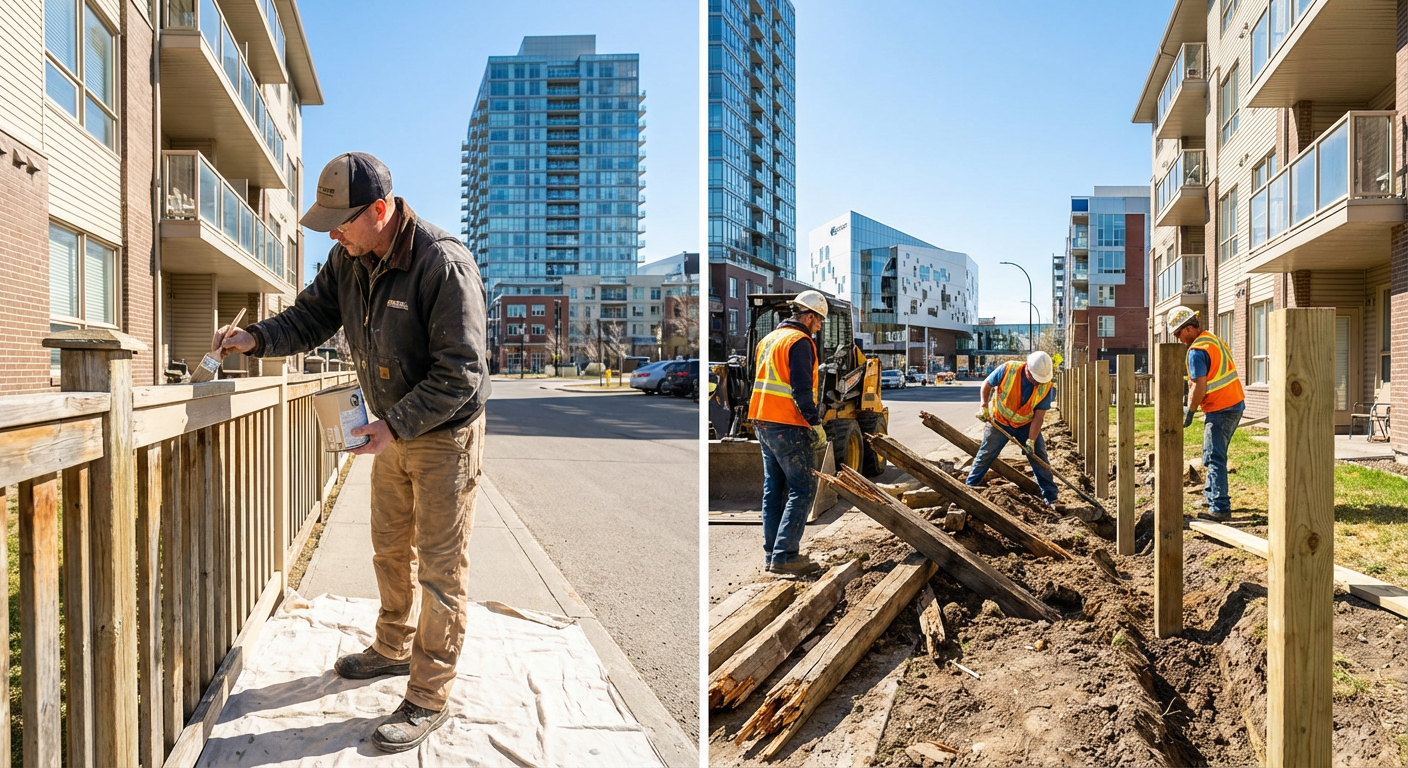
- Fence Repairs - Operating: Repairing a broken fence picket, fixing a gate latch, painting a 10-foot section
- Reserve: Replacing 50% or more of the fence because posts have rotted, complete fence replacement around the property perimeter
- Parking Lot Maintenance - Operating: Filling small potholes, touching up parking line paint, sealing minor cracks
- Reserve: Complete asphalt resurfacing in your Sherwood Park or St. Albert parking lot, structural repairs to parkade decks
- Plumbing Work - Operating: Fixing a leaking faucet in the party room, snaking a common area drain, replacing a toilet in the amenity washroom
- Reserve: Replacing all the water heaters, repiping corroded common area plumbing, sewer line replacement
- Roof Maintenance - Operating: Minor flashing repairs, clearing drains, replacing a few damaged shingles
- Reserve: Replacing an entire roof section, complete membrane replacement, major structural repairs to roof decking
Major Restorative Repairs: A Special Category
Your Alberta Reserve Fund Study should address "major restorative repairs"—significant work that extends an asset's useful life without fully replacing it. These repairs blur the line between maintenance and replacement but typically belong in the reserve fund when they:
- Involve substantial costs (generally more than 1-2% of the replacement value)
- Occur infrequently (less than once every few years)
- Require specialized contractors or engineering input
- Significantly extend the component's remaining useful life
For example, if your 15-year-old roof has another 15 years of expected life but needs major membrane patching covering 30% of the surface, that's a major restorative repair funded by reserves. It's not a full replacement, but it's far more extensive than routine maintenance.
Using Your Reserve Fund Study as Your Decision Framework
Your reserve fund study serves as your guidebook for these gray area decisions. A comprehensive study prepared by a Professional Engineer includes a detailed component inventory that categorizes building elements and estimates their remaining useful life and replacement costs.
When you're unsure whether an expense belongs in operating or reserve, consult your study:
- Is the component listed in your reserve fund study? If yes, major work on it probably belongs in reserves.
- What's the estimated replacement cost in your study? If your proposed work exceeds 20-30% of that cost, it's likely a reserve expense.
- What's the component's remaining useful life? If you're performing work to extend that life significantly, reserves may be appropriate.
For guidance on understanding your reserve fund study's component classifications, explore our Reserve Fund Study in Edmonton service page, which explains how P.Eng. professionals categorize building systems for Alberta condominiums.
Why Mixing Funds Creates Serious Liability Risks for Alberta Boards
The "wall" between operating and reserve funds isn't just a bookkeeping preference—it's a legal requirement under the Condominium Property Act Alberta. Violating this separation creates multiple risks for your condominium corporation and individual board members.
Auditor Red Flags and Financial Statement Issues
Alberta condominium corporations must have their financial statements audited or reviewed annually. When auditors examine your books, one of their key checks involves ensuring proper fund segregation. Misuse of reserve funds triggers immediate red flags:
- Direct Consequences - Qualified Audit Opinion: Auditors may issue a qualified opinion noting the improper fund usage, which damages your corporation's financial credibility
- Restated Financials: You may need to restate your financial statements, creating confusion and eroding owner confidence
- Increased Scrutiny: Future audits become more expensive and time-consuming as auditors look for patterns of mismanagement
- Insurance Implications: Errors and omissions insurance may not cover claims arising from deliberate non-compliance with the Act
Using reserve funds for operating expenses (or vice versa) violates Alberta regulations. While enforcement is often complaint-driven, violations can result in:
- Investigations by provincial regulators
- Orders to restore proper fund balances
- Potential fines or penalties
- Personal liability for board members who knowingly approved improper transfers
Owner Disputes and Legal Challenges
Unit owners have a vested interest in proper fund management. When they discover that board members have misallocated funds, disputes often follow:
- Common Owner Complaints - Special Assessment Challenges: If your corporation levies a special assessment because the operating fund is depleted (due to misusing reserves for operating expenses), owners may challenge the assessment's validity
- Underfunded Reserves: Conversely, if you've been paying for major repairs from operating funds, your reserve fund may be inadequate for future needs, requiring large catch-up contributions or assessments
- Transparency Issues: Mixing funds suggests poor financial oversight, leading owners to question other board decisions
- Property Value Impact: Prospective buyers reviewing your financial statements may see fund mismanagement as a red flag, potentially affecting unit values
In Alberta's competitive real estate markets—whether you're managing a high-rise in Calgary or a townhouse complex in Leduc—financial transparency and compliance directly affect property values and marketability.
The Emergency Exception: Limited and Temporary
Alberta regulations do provide narrow exceptions for inter-fund transfers during emergencies. Following the 2020 amendments to the Condominium Property Regulation, boards gained limited temporary authority to transfer funds between accounts during declared emergencies (such as the COVID-19 pandemic).
However, these exceptions are:
- Time-Limited: Only valid during the declared emergency period
- Reversible: Transfers must be repaid to the original fund when possible
- Documented: Require detailed record-keeping and transparency with owners
- Exceptional: Not intended for routine budget shortfalls or poor planning
Don't rely on emergency provisions as a safety net for poor budgeting. They exist for genuine crises, not as a workaround for inadequate reserve fund planning.
Special Considerations for New Developments
Newly developed condominiums in areas like Spruce Grove or Sherwood Park face unique challenges with fund management. When developers hand over a building to the owner-elected board, the reserve fund often starts at or near $0. The corporation must build the fund from scratch through monthly contributions based on the first reserve fund study.
During this build-up phase (typically 3-5 years), new boards face pressure to defer reserve contributions to keep condo fees low. However, this creates a dangerous cycle:
- Inadequate reserve fund contributions in early years
- Major components begin aging without adequate savings
- Forced special assessments when the first major repair becomes necessary
- Owner dissatisfaction and board turnover
- Continued cycle of underfunding and crisis management
New condominium corporations must resist the temptation to subsidize low condo fees by underfunding reserves. Working with a P.Eng. to develop a realistic long-term funding plan protects the corporation and individual unit owners from future financial shocks.
Our Reserve Fund Study in Calgary service helps new condominium corporations establish appropriate contribution levels from day one, avoiding the pitfalls that plague many Alberta developments during their first decade.
How Your Alberta Reserve Fund Study Provides Clarity and Direction
A professionally prepared reserve fund study does more than satisfy legal requirements—it serves as your financial roadmap for distinguishing between operating and reserve expenses. When prepared by a qualified Professional Engineer who understands Alberta's unique climate challenges and building codes, your study becomes an invaluable decision-making tool.
The Component Inventory: Your Classification Guide
The foundation of every reserve fund study is the component inventory—a detailed catalog of every major building system and element that will require repair or replacement over time. This inventory explicitly categorizes components as either:
- Reserve Fund Components: Major items with predictable lifecycles requiring substantial capital expenditure
- Operating Fund Components: Items maintained through routine annual budgets
- Exclusions: Items outside the corporation's responsibility (like unit interiors in most cases)
When your board faces a budgeting decision, the component inventory provides immediate clarity. If the item appears in your reserve fund study's inventory, major work on it belongs in the reserve budget. If it's not listed (or listed as an operating item), routine maintenance comes from operating funds.
Lifecycle Costing and Timing Guidance
Beyond simple categorization, your reserve fund study provides lifecycle cost analysis for each major component:
- Remaining Useful Life (RUL): How many years before replacement is needed
- Replacement Cost: Current estimated cost to replace the component
- Major Repair Costs: Estimated costs for significant mid-life repairs or restorations
This information helps boards plan multi-year budgets and understand the financial impact of delaying or accelerating major projects. For example, if your study shows your roof has 5 years of remaining useful life and a replacement cost of $200,000, you know that:
- You need $200,000 in your reserve fund within 5 years for this project
- Any major repairs in the meantime (like extensive membrane patching) should come from reserves if they cost more than typical annual maintenance
- You can't defer this expense to the operating fund without creating a significant shortfall
Funding Plan Recommendations
Your Alberta Reserve Fund Study includes funding plan recommendations—typically showing required annual contributions to maintain adequate reserve fund balances over a 25-30 year period. These recommendations account for:
- All scheduled major repairs and replacements
- Inflation and cost escalation
- Investment income on reserve fund balances
- Risk contingencies for unexpected failures
By following the funding plan, your board ensures adequate reserves are available when major expenses arise, eliminating confusion about whether operating funds should cover emergency repairs. A well-funded reserve means you'll never face the temptation to misallocate funds—the money is simply there when needed.
Engineering Expertise and Alberta-Specific Knowledge
Working with a Professional Engineer who specializes in reserve fund studies for Alberta condominium corporations provides advantages beyond regulatory compliance:
- Climate-Specific Insights - Understanding how Alberta's freeze-thaw cycles affect building lifecycles
- Accounting for snow load impacts on roofing systems in Edmonton and Calgary
- Recognizing moisture issues common in Alberta's dry climate
- Planning for temperature extremes that stress mechanical systems
- Local Building Code Knowledge - Ensuring replacement cost estimates reflect current Alberta Building Code requirements
- Anticipating mandatory upgrades when components are replaced
- Understanding how recent code changes affect major renovation projects
- Regional Cost Data - Using local contractor pricing for accurate replacement cost estimates
- Accounting for regional variations between Calgary, Edmonton, and smaller centers
- Understanding seasonal impacts on project timing and costs in Alberta
When you Get a Reserve Fund Study quote from a qualified P.Eng., you're not just buying a document—you're engaging a professional advisor who helps your board make informed decisions about operating versus reserve expenses throughout the study's validity period.

Creating Clear Policies and Procedures for Your Alberta Condo Board
Even with a comprehensive reserve fund study, your board benefits from establishing clear internal policies for expense classification. These policies create consistency across board terms and help property managers implement budgets correctly.
Developing an Expense Classification Policy
Your expense classification policy should provide decision-making guidelines for common scenarios:
Cost ThresholdsConsider establishing dollar thresholds that trigger automatic reserve fund consideration:
- Any single repair or project exceeding $5,000 (or another board-determined amount) requires evaluation for reserve fund appropriateness
- Repairs affecting more than 25% of a building system automatically come from reserves
- Any work requiring a building permit typically qualifies as a reserve expense
Clarify who can approve reserve fund expenditures:
- Emergency repairs under $X can be approved by the property manager and board president
- Planned reserve projects require full board approval
- Reserve projects exceeding $Y require owner notification before proceeding
Establish what documentation is needed for reserve fund draws:
- Engineering reports or assessments justifying the work
- Multiple contractor quotes (typically 3 quotes for projects over $X)
- Board meeting minutes recording the approval decision
- Clear notation in accounting records linking expenses to specific reserve fund components
The Property Manager's Role in Fund Management
Your property manager serves as the first line of defense in maintaining proper fund separation. Ensure your manager understands:
- Daily Operational Clarity - Which bank accounts correspond to operating versus reserve funds
- Standard vendor payments that always come from operating (landscaping, snow removal, utilities)
- Repair scenarios that require board consultation before payment
- Budget Preparation Support - Annual operating budget should exclude any major repair or replacement items
- Reserve fund budget should align with the current reserve fund study's expenditure forecast
- Mid-year adjustments require board approval and clear documentation
- Financial Reporting Standards - Monthly financial statements must show operating and reserve funds separately
- Year-end statements must clearly categorize all expenses by fund
- Annual audits should include reserve fund transaction summaries
Training and Continuity for Board Turnover
Alberta condo boards experience regular turnover as owners rotate on and off. This turnover creates knowledge gaps that can lead to poor decisions about fund management. Implement strategies to maintain institutional knowledge:
- New Board Member Orientation - Review of the current reserve fund study during onboarding
- Overview of the expense classification policy
- Historical context on major projects and funding decisions
- Introduction to the property manager and other professionals
- Annual Budget Process Training - Dedicated session explaining operating versus reserve fund budgeting
- Review of the reserve fund study's expenditure forecast for the coming year
- Discussion of any borderline items requiring classification decisions
- Professional Resources - Maintain relationships with your reserve fund study provider for consultation
- Consider annual or biennial check-ins with your P.Eng. to review fund adequacy
- Engage legal counsel when complex situations arise
For boards managing properties across Alberta—from Red Deer to smaller communities—maintaining this consistency and knowledge base protects both the corporation and individual board members from liability.
Visit our Reserve Fund Study in Red Deer page to learn how we support smaller communities with the same professional standards as larger Alberta cities.
Reserve Fund Studies Across Alberta
We provide Reserve Fund Studies for condominium corporations across Alberta, including Edmonton, Calgary, and Red Deer.
Ready to get started? Get a Reserve Fund Study Quote →