Need a Reserve Fund Planner in Alberta?
Brookstone Engineering is a reserve fund study planner with in-house APEGA-licensed Professional Engineers (P.Eng.) serving Edmonton Metro, Calgary Metro and Central Alberta. Request a Reserve Fund Study Quote (Alberta)
A reserve fund plan is a strategic financial document that projects the long-term funding requirements for a condominium corporation's major repair and replacement needs, but when built on unrealistic assumptions or inadequate data, it can leave your building critically underfunded. For condominium boards across Alberta, recognizing the warning signs of an unrealistic reserve fund plan isn't just about financial prudence—it's about protecting your community's future and avoiding special assessments that can devastate owners.
Whether you're reviewing your current reserve fund study or evaluating a newly completed report, understanding these risk flags can help you make informed decisions about your building's financial health. This guide will help Alberta condominium boards identify the red flags that signal potential problems with their reserve fund planning.
What Makes a Reserve Fund Plan Unrealistic?
An unrealistic reserve fund plan typically stems from flawed assumptions, inadequate inspections, or pressure to keep contribution rates artificially low. These plans create a false sense of financial security while your building deteriorates and repair costs escalate beyond your funding capacity.
The Foundation of Sound Planning
A realistic reserve fund study depends on three critical elements: accurate building condition assessment, reasonable cost projections, and honest financial modeling. When any of these elements contains optimistic bias or insufficient data, the entire plan becomes unreliable.
In Alberta's condominium market, where construction costs have increased significantly in recent years and weather conditions accelerate component deterioration, conservative assumptions aren't pessimistic—they're prudent. The Reserve Fund Study Services in Alberta that condominium corporations rely on must account for local market conditions and climate-specific challenges.
The Cost of Optimistic Planning
Boards that accept unrealistic reserve fund plans often face painful consequences within just a few years. Special assessments become necessary when major projects exceed budgeted amounts, monthly fees require dramatic increases to catch up on funding shortfalls, and property values decline as potential buyers recognize financial instability.
How Can You Identify Inflation Rate Red Flags?
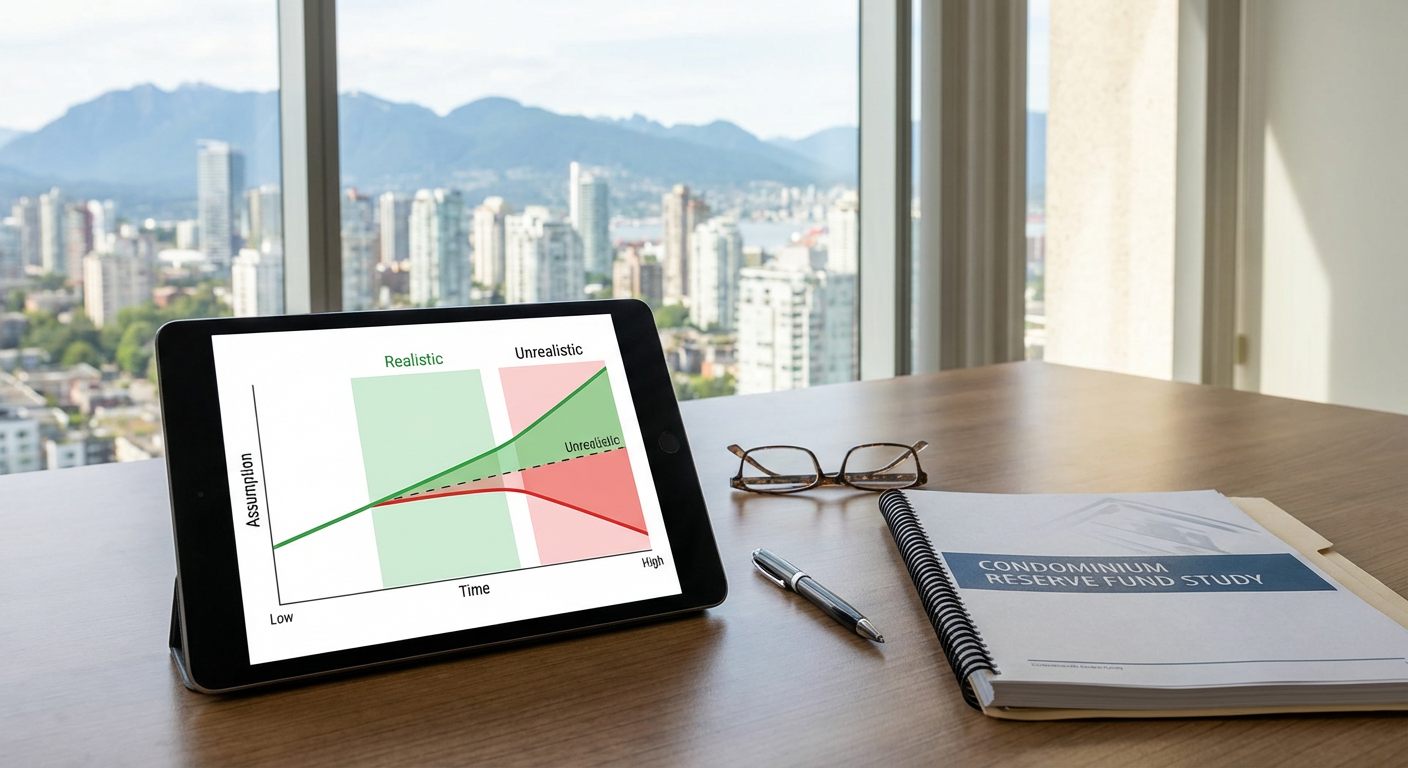
Inflation assumptions represent one of the most critical variables in reserve fund planning, yet they're often manipulated to make funding requirements appear more manageable. Understanding how to evaluate these assumptions protects your condominium corporation from systematic underfunding.
Warning Signs in Inflation Projections
When reviewing your reserve fund plan, be immediately skeptical of inflation rates below 2% annually for construction costs. Alberta has experienced construction cost inflation averaging between 3.5% and 5% over the past decade, with some years exceeding 6%. A study projecting below 2% inflation essentially guarantees that actual costs will exceed budgeted amounts.
Different cost inflation rates for different components can be appropriate, but watch for studies that apply uniformly low rates across all building systems. Roofing materials, mechanical systems, and concrete restoration have historically inflated faster than general consumer prices, and responsible Reserve Fund Study in Edmonton providers account for these variations.
The Compound Effect Problem
Small differences in inflation assumptions create massive funding gaps over time through the power of compounding. A $100,000 roof replacement projected 15 years into the future at 2% inflation totals $134,587, while the same project at 4% inflation costs $180,094—a difference of $45,507 that must come from somewhere when replacement time arrives.
Boards should request sensitivity analysis showing how different inflation scenarios affect total funding requirements. Studies that don't provide this analysis or dismiss the importance of inflation assumptions often signal unrealistic planning.
What Are the Red Flags in Component Lifecycle Estimates?
Component lifecycle projections determine when major expenditures will occur, directly impacting both the timing and size of reserve fund contributions. Generic or optimistic lifecycle assumptions create funding mismatches that leave boards scrambling when components fail earlier than predicted.
Generic vs. Site-Specific Analysis
One of the clearest reserve fund study red flags involves lifecycle estimates pulled from industry averages without adjustment for your building's actual condition. A generic assumption that asphalt shingles last 25 years might be reasonable in moderate climates, but Alberta's temperature extremes, high UV exposure, and severe weather events often reduce shingle lifespan to 18-22 years.
Professional engineers conducting thorough reserve fund studies document the current condition of each component and adjust lifecycle estimates based on observed deterioration rates, maintenance history, and local climate factors. Studies lacking this site-specific analysis often project unrealistically long lifecycles that defer necessary expenditures beyond prudent timelines.
The Maintenance History Factor
Your building's maintenance history significantly affects component lifecycles, yet many studies ignore this critical data. A mechanical system receiving regular preventive maintenance may exceed typical lifecycle estimates, while neglected systems fail prematurely. Reserve fund plans that don't request or analyze maintenance records miss crucial information affecting financial projections.
Reserve Fund Study in Calgary providers like Brookstone Engineering understand how maintenance practices affect component longevity and adjust lifecycle estimates accordingly. Studies that project identical lifecycles for well-maintained and neglected systems lack the nuanced analysis that accurate planning requires.Climate and Environmental Considerations
Alberta's climate presents unique challenges that generic lifecycle estimates often underestimate. Freeze-thaw cycles stress concrete and masonry, wind-driven rain tests building envelope integrity, and temperature extremes challenge mechanical systems. Studies that fail to account for these factors systematically overestimate component lifecycles.
Exterior components particularly require climate-adjusted lifecycle projections. Parking lot asphalt deteriorates faster in Alberta than in moderate climates due to snow removal operations and freeze-thaw damage. Balcony waterproofing fails prematurely when drainage systems freeze and crack. Reserve fund plans that ignore these local factors create dangerous funding gaps.
How Do You Spot Problems in Cost Estimates?
Cost projection accuracy determines whether your reserve fund will actually cover planned expenditures when they become necessary. Unrealistic cost estimates represent one of the most common and dangerous flaws in reserve fund planning.
The Dated Information Problem
Construction costs in Alberta have increased dramatically in recent years, particularly for specialized condominium work. Reserve fund studies more than three years old likely contain cost estimates that no longer reflect current market conditions, and studies that rely on outdated unit costs create systematic underfunding.
Realistic cost estimates come from recent contractor quotes, current construction cost databases specific to Alberta markets, and professional judgment that accounts for market trends. Studies that don't cite their cost information sources or rely on outdated pricing should trigger immediate concern.
Missing Contingency Allowances
Professional reserve fund plans include contingency allowances recognizing that actual project costs often exceed estimates due to unforeseen conditions, scope changes, or market fluctuations. Studies projecting exact costs without any contingency buffer demonstrate unrealistic precision and poor risk management.
Industry standards suggest contingency allowances between 10% and 20% for major projects, depending on the complexity and uncertainty involved. Studies that omit contingencies or use unusually low percentages create situations where actual expenditures exceed available reserves, forcing special assessments or project delays.
Scope Definition Issues
Cost estimates depend on clearly defined project scopes, yet many reserve fund studies use vague descriptions that hide potential costs. A projection for "roof replacement" might exclude necessary structural repairs, ventilation upgrades, or asbestos abatement that often accompany roofing projects on older buildings.
Detailed cost breakdowns indicating the assumptions behind each estimate help boards understand what's included and what additional costs might arise. Studies that provide only lump-sum cost figures without supporting detail make it impossible to evaluate estimate accuracy or completeness.
What Financial Calculation Red Flags Should You Watch For?
Even when physical assessments and cost estimates seem reasonable, flawed financial modelling can render a reserve fund plan unrealistic. Understanding these calculation red flags helps boards identify planning problems before they cause financial crises.

The Low Contribution Increase Warning
Reserve fund plans that project minimal annual contribution increases—typically below 5% per year—often signal that difficult financial decisions have been deferred rather than addressed honestly. With inflation alone running 3-4% annually, contribution increases significantly below this rate mean your funding isn't keeping pace with growing costs.
Boards should be particularly skeptical of plans that project level contributions for several years followed by large increases. This approach often indicates that the plan optimistically assumes conditions won't change or that future boards will implement painful increases that current boards want to avoid.
Negative Cash Flow Projections
One of the clearest unrealistic reserve fund assumptions appears when year-end fund balances show negative numbers in future years. This indicates the plan projects spending more money than the fund will contain—an obviously impossible situation that typically results from overly optimistic funding formulas or understated expenditure timing.
Professional reserve fund studies maintain positive fund balances throughout the projection period while targeting appropriate percent funded levels. Plans showing negative balances essentially admit they're underfunded but hope something will change before the shortfall becomes critical.
The Percent Funded Deception
Percent funded represents the ratio between your current reserve fund balance and the total amount you should have accumulated based on component deterioration to date. However, this metric only means something when based on realistic component values and lifecycle estimates.
A plan might project 80% funded status—seemingly healthy—but if based on underestimated component costs or overestimated lifecycles, the actual funding level could be far lower. Boards should examine the assumptions underlying percent funded calculations rather than accepting the number at face value.
Unrealistic Investment Return Assumptions
Some reserve fund plans assume aggressive investment returns on fund balances to reduce required contribution rates. While Alberta condominium corporations can earn returns on properly invested reserves, assumptions exceeding 3-4% annually for conservative investments represent unrealistic expectations that leave funding dependent on market performance.
Reserve fund planning should use conservative investment return assumptions recognizing that preservation of capital takes priority over return maximization. Plans assuming 5-6% annual returns essentially gamble with your building's financial future.
How Can Building Inspection Quality Affect Plan Reliability?
The foundation of any reserve fund plan lies in the physical inspection that determines component conditions and remaining lifecycles. Inadequate inspections guarantee unrealistic planning regardless of how sophisticated the financial modeling appears.
The Desktop Study Problem
Some reserve fund providers offer "desktop studies" that update previous reports without conducting new physical inspections. While this approach costs less, it cannot identify deterioration that has occurred since the last inspection or verify that previous condition assessments remain accurate.
True reserve fund studies require on-site inspections by qualified professionals who can identify hidden deficiencies, verify component conditions, and recognize problems that property managers or board members might miss. Studies conducted primarily from existing documentation and remote reviews often contain dangerously optimistic condition assessments.
Professional Qualifications Matter
In Alberta, reserve fund studies don't legally require preparation by Professional Engineers (P.Eng.), but engineering credentials provide assurance that the consultant has technical expertise to accurately assess building systems and project remaining lifecycles. Studies prepared by individuals without relevant technical credentials may miss structural issues, mechanical deficiencies, or building envelope problems that require immediate attention.
When reviewing reserve fund study credentials, consider whether the inspectors have relevant experience with condominium buildings, understand Alberta's climate challenges, and possess professional liability insurance protecting your corporation from inaccurate assessments.
Inspection Scope and Access
Even qualified inspectors produce unrealistic plans when access limitations prevent thorough evaluation. Reserve fund studies should document inspection scope and note areas where access was restricted, enabling boards to understand what wasn't examined and what additional investigation might be necessary.
Warning signs include studies that don't mention roof access, mechanical room inspections, or destructive investigation of building envelope assemblies when problems are suspected. Comprehensive Reserve Fund Study services in Alberta include detailed physical inspection protocols that leave no major component unexamined.
What Role Does Update Frequency Play?
Reserve fund plan accuracy degrades over time as conditions change, costs increase, and new information becomes available. Understanding when your plan becomes unrealistic helps boards maintain appropriate funding levels and avoid surprises.
Alberta's Update Requirements
Alberta's Condominium Property Regulation requires corporations to review their reserve fund plan annually and update the study at least every five years. However, waiting the full five years between updates often results in plans that have become significantly unrealistic as market conditions change and components deteriorate.
Best practices suggest updating reserve fund studies every three years in stable markets and more frequently when construction costs are rising rapidly or major projects reveal unexpected conditions. Boards relying on studies approaching or exceeding five years old should recognize they're operating with increasingly unrealistic information.
Triggering Events for Early Updates
Certain events should trigger immediate reserve fund study updates regardless of when the last study was completed. These include major project costs exceeding estimates by more than 20%, discovery of significant unexpected deficiencies, changes in building use or intensity, and acquisition of additional property or common elements.
Market condition changes can also justify early updates. When Alberta construction costs increased rapidly in recent years, reserve fund studies just two years old contained cost estimates that no longer reflected reality, leaving corporations systematically underfunded even when following their plans precisely.
The Cost of Outdated Information
Operating with an outdated reserve fund plan costs more than the update study would expense. Contribution rates that seemed adequate when the plan was prepared fall short as actual costs exceed projections, special assessments become necessary to cover funding gaps, and emergency repairs replace planned replacements when components fail earlier than anticipated.
Get a Reserve Fund Study quote to ensure your plan reflects current conditions and market realities. The investment in an updated study provides financial certainty and protects against the much larger costs of inadequate planning.
What Questions Should Boards Ask Their Reserve Fund Provider?
Engaging effectively with reserve fund study providers helps boards identify potential problems early and ensure they receive realistic, actionable plans. Knowing which questions to ask demonstrates due diligence and encourages comprehensive analysis.
Questions About Methodology
Start by understanding the provider's inspection and analysis methodology. Ask how many site visits will occur, who will conduct inspections, what credentials inspectors possess, and how much time will be spent on-site. Providers offering unusually low prices often cut corners on inspection thoroughness—the foundation of accurate planning.
Request information about cost estimation sources and update frequency. Reliable providers use current Alberta-specific cost databases, recent project experience, and contractor input rather than national averages or outdated information. Ask whether costs include contingencies and what assumptions underlie major expenditure projections.
Questions About Assumptions
Understanding the assumptions driving your reserve fund plan helps identify unrealistic projections. Ask what inflation rate will be used and how it was determined, how component lifecycles were established and whether they account for your building's specific conditions, and what investment return assumptions affect funding calculations.
Don't accept vague or evasive answers. Professional reserve fund providers should clearly explain their assumptions and the reasoning behind them. Providers who cannot or will not discuss assumption details may be hiding optimistic projections designed to please boards rather than inform them accurately.
Questions About Customization
Generic reserve fund studies that don't account for your building's unique characteristics often contain unrealistic projections. Ask how the study will address your specific maintenance history, climate-related challenges in Alberta, building design features that affect component performance, and any known deficiencies or concerns board members have identified.
Studies that treat every building identically regardless of age, construction quality, maintenance practices, or location cannot provide the customized analysis that realistic planning requires. Reserve Fund Study in Red Deer providers should demonstrate understanding of local conditions and your building's specific situation.
How Can Boards Validate Reserve Fund Plan Assumptions?
Even when working with qualified professionals, boards should validate key assumptions rather than accepting them at face value. This due diligence protects against unrealistic planning and ensures your corporation's financial decisions rest on solid foundations.
Independent Cost Verification
One effective validation method involves obtaining independent cost estimates for major upcoming projects. When your reserve fund study projects roof replacement costs of $300,000 in two years, request preliminary quotes from roofing contractors to verify whether the estimate is realistic.
Significant discrepancies between reserve fund cost estimates and independent quotes signal problems requiring investigation. Either the reserve fund study scope differs from what contractors are pricing, cost estimates are outdated, or the study contains unrealistic assumptions that need correction.
Peer Comparison Analysis
Comparing your reserve fund plan to similar buildings provides reality checks on key assumptions. Network with boards of comparable condominium corporations to discuss their reserve fund experiences, contribution rates, and major project costs. While every building differs, dramatic variations often indicate one plan contains unrealistic assumptions.
Professional condominium management companies can facilitate these comparisons by sharing anonymized data from their portfolio of buildings. Boards discovering their projected contribution rates are significantly lower than comparable buildings should investigate whether their plan contains unrealistic assumptions or whether they've truly achieved superior funding efficiency.
Expert Second Opinions
When boards have concerns about their reserve fund plan but lack expertise to identify specific problems, engaging another qualified professional for a limited review provides valuable perspective. This consultation doesn't require a complete new study—just expert evaluation of assumptions, methodology, and conclusions.
Second opinions are particularly valuable when considering major strategic decisions based on reserve fund projections, such as significant contribution rate changes, major project timing, or special assessments. The modest cost of expert review pales compared to the financial impact of decisions based on unrealistic plans.
Reserve Fund Studies Across Alberta
We provide Reserve Fund Studies for condominium corporations across Alberta, including Edmonton, Calgary, and Red Deer.
Ready to get started? Get a Reserve Fund Study Quote