Reserve fund study AGM presentation tips are communication strategies that help condominium boards translate complex reserve fund study findings into clear, actionable insights that Alberta condo owners can understand and support at annual general meetings. For condominium boards and property managers across Alberta, presenting reserve fund study results effectively at AGMs can mean the difference between smooth approval of funding plans and contentious meetings filled with confusion and resistance.Need a Reserve Fund Study in Edmonton?
Brookstone Engineering is a reserve fund study provider with in-house APEGA-licensed Professional Engineers (P.Eng.). Request a Reserve Fund Study Quote (Edmonton)
The real challenge with reserve fund study AGM presentation tips isn't mastering the mathematics behind funding models—it's building trust with owners who fear surprises, unclear decisions, and unexpected financial impacts. When Alberta boards master the art of explaining what's coming, when it will happen, and what it means for monthly fees using proven reserve fund study AGM presentation tips, they transform potentially divisive meetings into constructive planning sessions that strengthen community confidence and protect property values.
Why Do Reserve Fund Study AGM Presentations Often Go Wrong?
Most reserve fund study AGM presentations fail not because the study itself is flawed, but because boards attempt to share every detail of a 100-page technical report in a 20-minute presentation. Owners receive information in the wrong sequence, using terminology they don't understand, focused on engineering minutiae rather than financial impact. Effective reserve fund study AGM presentation tips address these common pitfalls systematically.
The solution lies in understanding what owners actually need to hear versus what the full reserve fund study contains. A comprehensive reserve fund study prepared by a P.Eng. in Alberta includes detailed component inventories, lifecycle analysis, cash flow projections, and funding models—all critical for compliance and planning. But at the AGM, owners need a different kind of information: a clear narrative about their building's future and what it means for their investment.
Understanding Owner Psychology at Reserve Fund Study AGMs
Alberta condominium owners attending AGMs aren't engineers or accountants—they're homeowners who want to protect their investment without financial shocks. When presenting reserve fund study results using these reserve fund study AGM presentation tips, boards must recognize that emotional reactions often precede logical understanding. An owner who sees "roof replacement: $450,000" immediately thinks about special assessments and fee increases before processing that this expense is seven years away and planned for through gradual contributions.
Effective reserve fund study AGM presentation tips acknowledge these psychological responses by leading with reassurance: "This study helps us avoid surprises" before diving into specific projects and costs. When owners understand the purpose before seeing the numbers, they're more likely to view the reserve fund study as a planning tool rather than a crisis announcement.

What Information Do Owners Actually Want to Know at Reserve Fund Study AGMs?
Successful owner meeting reserve fund presentations following proven reserve fund study AGM presentation tips follow a specific sequence that matches how people process financial information. Presenting reserve fund study results out of this order creates confusion and resistance, even when the underlying plan is sound.
The Five Questions Every Owner Asks Silently
What's the next big project?Owners want to know immediately what major work is coming. For many Alberta condominiums, this might be parkade membrane replacement, building envelope repairs, or mechanical system upgrades. Starting with the most imminent project grounds the entire presentation in concrete terms owners can visualize. This is among the most important reserve fund study AGM presentation tips: answer the immediate concern first.
When is it likely to happen?Timing matters enormously to owners planning their finances. A project in Year 1 requires different preparation than one in Year 8. Be specific about timing windows while explaining that reserve fund studies provide forecasts, not guarantees—component conditions and costs can change, which is why regular updates matter. These reserve fund study AGM presentation tips emphasize transparency about uncertainty.
How much will it cost?Once owners understand what and when, they're ready for cost information. Present this in ranges when appropriate, and always explain that costs reflect current dollars adjusted for inflation. For major projects in Alberta, context helps: "A full parkade membrane replacement typically costs $150-200 per square foot in Edmonton, which means approximately $300,000 for our 1,800-square-foot parkade."
What does this do to my condo fees (or special assessment risk)?This is the question that determines approval or resistance. Owners need clear explanation of how reserve fund contributions translate to monthly fees, and how the recommended funding model prevents special assessments. Specific examples work best using reserve fund study AGM presentation tips: "Following this plan means contributions increase by $25 per month per unit rather than a $5,000 special assessment in three years."
What is the board recommending right now?After presenting the full picture, boards must make a clear recommendation. Ambiguity at this stage undermines all the work done to explain results. Be specific: "The board recommends adopting Option 2, the component-based funding model, which increases monthly contributions by $30 per unit starting next quarter and maintains a minimum 65% funded ratio throughout the 25-year planning period."
How Should Boards Structure a Reserve Fund Study AGM Narrative?
The most effective reserve fund study AGM presentation tips provide boards with a repeatable narrative structure that any board member can deliver confidently. This script has been refined through dozens of Alberta AGMs and consistently produces constructive discussions rather than confrontational meetings.
Opening: Establish Purpose (30 Seconds)
"Good evening everyone. Tonight we're presenting the results of our reserve fund study, which was completed last month by a Professional Engineer licensed in Alberta. This study is our long-range plan to avoid emergency funding situations. It helps us forecast major repairs over the next 25 years and set contributions so we're never caught by surprise with projects we should have seen coming."
This opening immediately frames presenting reserve fund study results as proactive planning rather than delivering bad news. The mention of a P.Eng. establishes credibility without dwelling on technical qualifications—a key element of reserve fund study AGM presentation tips.
Building Context: Major Cost Drivers (60 Seconds)
"Our building has five major components that drive most of our long-term capital costs: our roof system, which will need replacement in approximately 8 years; our parkade membrane, which is showing early signs of wear and will need addressing in 4-6 years; our boiler and mechanical systems, with staggered replacement cycles; our building envelope including windows and cladding; and our elevators, which are approaching mid-lifecycle major modernization."
"These aren't problems—they're predictable lifecycle costs that every building faces. In Alberta's climate, we see accelerated wear on exterior components due to freeze-thaw cycles, which is why regular inspections and planned replacement matter so much."
Explaining Changes Since Last Study (60 Seconds)
"Since our last reserve fund study five years ago, several things have changed. We successfully completed the hallway carpet replacement on budget. We discovered during inspections that our roof membrane is aging slower than originally projected, which pushed that replacement out by two years. However, construction cost inflation has been significant—we're seeing 15-20% increases in major project costs compared to 2021 estimates in Alberta. We've also identified accelerated deterioration in the parkade due to de-icing salt exposure, which moved that project timeline forward."
This section demonstrates that the board actively monitors building conditions and adjusts plans based on real data rather than blindly following old projections. These reserve fund study AGM presentation tips build credibility through transparency.
How Can You Explain Reserve Fund Study Results Without Overwhelming Spreadsheets?
The greatest reserve fund study AGM presentation tip we can offer is this: never project a full spreadsheet at an owner meeting. Detailed cash flow projections and component tables are essential tools for board planning, but at AGMs they overwhelm rather than inform. Effective reserve fund study AGM presentation tips focus on digestible frameworks.
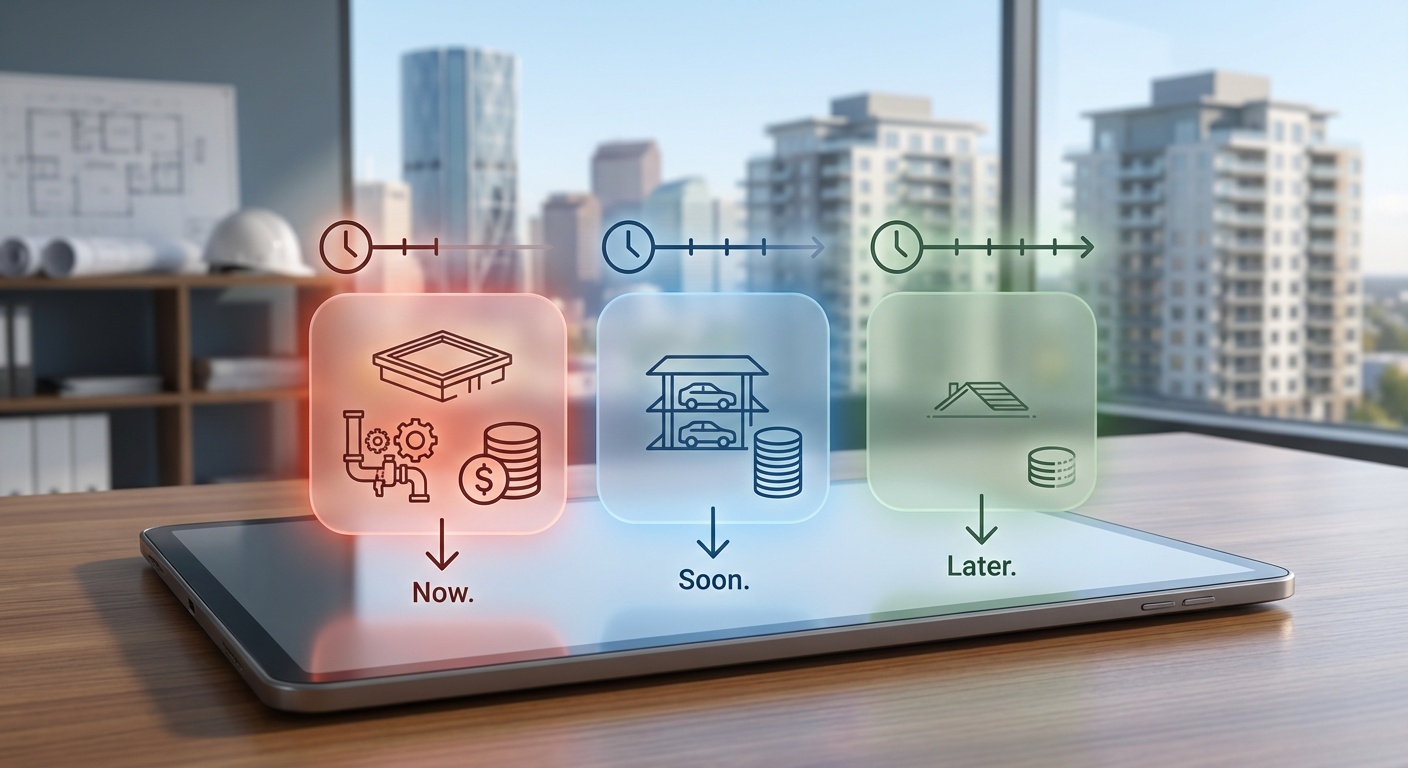
The "Now / Soon / Later" Framework
Transform complex multi-year capital plans into three simple time horizons that owners can easily grasp—this is one of the most powerful reserve fund study AGM presentation tips:
- Now (0-2 Years) – What's Imminent: - Hallway lighting LED conversion: $18,000 (Year 1)
- Parkade concrete spalling repairs: $35,000 (Year 2)
- Boiler #2 replacement: $45,000 (Year 2)
- Total Near-Term Capital Work: $98,000
- Soon (3-7 Years) – What's Next: - Parkade membrane replacement: $320,000 (Year 5)
- Roof replacement: $285,000 (Year 7)
- Elevator cab modernization: $65,000 (Year 6)
- Total Mid-Term Capital Work: $670,000
- Later (8+ Years) – What's on the Horizon: - Building envelope restoration: $450,000 (Year 12)
- Boiler #1 replacement: $45,000 (Year 10)
- Window replacement program: $380,000 (Year 15)
- Total Long-Term Major Projects: $875,000+
This framework answers the "when" question while making the funding strategy clear using reserve fund study AGM presentation tips: we're setting aside money gradually for all three horizons, not scrambling when projects hit.
Highlighting Top Components by Cost
Owners understand rankings intuitively. Present your building's top ten components by 30-year projected cost—this is among the most effective reserve fund study AGM presentation tips for Alberta condominiums:
- Building envelope: $450,000 – Your largest single investment, protecting everything inside
- Parkade membrane & structure: $385,000 – Critical for preventing water damage to the building foundation
- Roof system: $285,000 – Complete membrane replacement with improved drainage
- Mechanical systems: $220,000 – Three boiler replacements over 25 years plus controls
- Windows & doors: $180,000 – Phased replacement maintaining energy efficiency
- Elevators: $145,000 – Modernization and lifecycle component replacement
- Landscaping & site: $95,000 – Irrigation, paving, retaining walls, drainage
- Interior common areas: $75,000 – Hallways, lobby, amenity spaces
- Fire & life safety: $65,000 – Panel upgrades, sprinkler testing, exit lighting
- Electrical infrastructure: $55,000 – Panel upgrades, emergency power, common area circuits
Explain that these aren't "scary" numbers—they represent predictable lifecycle costs spread over decades. A $450,000 building envelope project over 30 years represents just $15,000 annually in contributions for that component alone.
Translating Funding Into Owner Impact
This is where owner meeting reserve fund communication becomes most critical using reserve fund study AGM presentation tips. Owners need to understand three funding approaches and their implications:
Planned Regular Contributions (Recommended):"Under this model, contributions increase by $35 per unit per month starting next quarter, then adjust modestly every five years based on updated studies. This approach keeps our reserve fund balance above 60% funded throughout the planning period, maintains stable monthly costs, and eliminates special assessment risk for planned projects."
Special Assessment Strategy (Higher Risk):"Alternatively, we could keep contributions minimal and use special assessments when projects arise. For example, when the parkade work hits in Year 5, each owner would face a $4,200 special assessment. Two years later, roof replacement would trigger another $3,800 assessment. This creates financial hardship, increases delinquency risk, and makes units harder to sell in Alberta's competitive market."
Borrowing Approach (Long-Term Cost):"A third option is borrowing for major projects. While this spreads costs over time, we'd pay significant interest—roughly 25-30% more than the actual project cost—and we'd be locked into rigid repayment schedules that limit flexibility for other projects."
What Are the Most Common Objections at Reserve Fund Study AGMs?
No matter how well you apply reserve fund study AGM presentation tips, certain objections arise at every AGM. Preparing responses in advance transforms difficult moments into opportunities to build understanding.
"Why Are Fees Going Up?"
Owner Concern:"We just had a fee increase two years ago. Why do we need another one?"
Effective Response Using Reserve Fund Study AGM Presentation Tips:"Fees are increasing because we're choosing planned funding over emergency funding. Two years ago, we increased fees to address our operating budget shortfall. This increase addresses our capital plan—the major projects every building faces. Without this increase, we'd face special assessments averaging $3,000-5,000 per unit every few years in Alberta. The choice is really between predictable monthly increases or unpredictable large assessments. Monthly increases also mean new buyers gradually take on their fair share of upcoming costs rather than current owners paying for everything."
"Why Pay Now for Something 10 Years Away?"
Owner Concern:"The building envelope work is 12 years away. Why are we contributing to that now?"
Effective Response: "This is about fairness across all owners over time—a core principle in reserve fund study AGM presentation tips. If we wait until Year 11 to start funding a $450,000 project, whoever owns units then would bear the entire cost—even though current owners benefit from that envelope for the next decade. By contributing gradually starting now, everyone who uses the building contributes proportionally to its maintenance. This also means smaller contributions spread over more years rather than dramatic increases or special assessments as projects approach.""Can't We Just Do a Special Assessment Later?"
Owner Concern:"Special assessments give us more flexibility. Why commit to higher fees now?"
Effective Response: "Special assessments create three significant problems in Alberta condominiums. First, they create financial hardship—many owners can't easily access $5,000-10,000 on short notice, leading to payment plans, delinquencies, and collection issues. Second, they harm resale value. Potential buyers see pending special assessments and walk away or negotiate lower prices. Third, they often come with higher contractor costs because we can't negotiate as effectively when projects are urgent rather than planned years in advance. Planned funding through regular contributions actually saves money long-term.""How Accurate Is This Really?"
Owner Concern:"These are just estimates. How do we know costs won't be completely different?"
Effective Response: "You're right that this is a forecast, not a guarantee—which is exactly why we update the study every five years as required by Alberta regulations. The engineer conducting the study visits the building, inspects components, reviews maintenance records, and applies industry-standard lifecycle and costing data. Costs will vary somewhat, which is why we build contingency into the plan and maintain a minimum funded percentage. Over time, the projections become increasingly accurate as we complete projects and gather actual cost data. This is far more reliable than not planning at all—a fundamental truth behind reserve fund study AGM presentation tips."
What Information Should You Share at the AGM Versus Keep Available?
Effective AGM reserve study communication using proper reserve fund study AGM presentation tips requires thoughtful curation of information. The goal isn't to hide details—it's to present digestible information during the meeting while making comprehensive documentation available for those who want deeper understanding.
Share During the Presentation (Confidence-Building Essentials)
0-5 Year Project Outlook:Present a clear list of all projects planned for the immediate future, with costs and approximate timing. This shows owners exactly what their contributions are funding in the near term—a critical element of reserve fund study AGM presentation tips.
Top 10 Components by Cost:As described earlier, this ranking helps Alberta owners understand where their long-term contributions are directed and why certain components receive planning priority.
Funding Recommendation Summary:Present the board's recommended funding approach with three key metrics: monthly contribution per unit, projected reserve fund balance over time (shown as percentage funded), and comparison to special assessment scenarios.
Specific Motion for Vote:Every presentation must conclude with a clear motion: "The board moves that the corporation adopt the component-based funding model as recommended in the 2024 reserve fund study, resulting in monthly reserve contributions of $235 per unit effective April 1, 2024."
Keep Available as Reference (Detailed Supporting Information)
Full Component Tables:The complete inventory of all common property components with condition ratings, remaining useful life, replacement costs, and lifecycle assumptions belongs in the full report made available digitally or in the management office.
Detailed Cash Flow Projections:Year-by-year cash flow showing opening balances, contributions, expenditures, interest, and closing balances helps interested owners understand the financial mechanics but overwhelms most people during a presentation applying reserve fund study AGM presentation tips.
Methodology and Assumptions:The engineer's explanation of inspection methodology, lifecycle assumptions, cost estimating approaches, and inflation factors serves important technical documentation purposes but rarely affects owner decision-making at AGMs.
Component Photos and Condition Details:Visual documentation of component conditions provides valuable reference but works better as supplementary material than presentation content.
How Should Boards Prepare for Reserve Fund Study AGM Presentations?
Successful reserve study AGM presentations using effective reserve fund study AGM presentation tips require thorough preparation weeks before the meeting. This checklist ensures nothing falls through the cracks for Alberta condominium boards:
- Six Weeks Before AGM: - Confirm AGM date and what decisions require owner approval versus board authority
- Engage reserve fund study provider or confirm completion of current study
- Review study results with full board to ensure understanding and alignment on reserve fund study AGM presentation tips
- Identify 3-5 headline components to emphasize in the presentation
- Four Weeks Before AGM: - Prepare one-page owner summary highlighting key findings and recommendations using reserve fund study AGM presentation tips
- Create presentation slides or talking points following the narrative structure above
- Draft motions requiring owner votes (funding model adoption, fee increases)
- Schedule review meeting with property manager to coordinate presentation delivery
- Two Weeks Before AGM: - Distribute AGM notice package including one-page reserve fund study summary
- Post full reserve fund study report to owner portal or make available for review
- Prepare answers to likely questions based on objections outlined above using reserve fund study AGM presentation tips
- Confirm which board members will present which sections of results
- One Week Before AGM: - Rehearse presentation to ensure timing (aim for 15-20 minutes maximum)
- Verify all financial figures match current budget and reserve fund balance
- Prepare handouts for owners attending in person
- Set up technology for virtual attendees if hybrid meeting
- Day of AGM: - Arrive early to test presentation technology and room setup
- Have printed copies of one-page summary and motions available
- Designate one board member to handle questions (avoid multiple people answering simultaneously)
- Record meeting if permitted to support accurate minute-taking
- After AGM: - Distribute meeting minutes within required timeframe
- Follow up with owners who had specific questions requiring research
- Implement approved funding changes promptly
- Schedule reserve fund study update for five years from current study date
This systematic approach to AGM reserve study communication using proven reserve fund study AGM presentation tips significantly reduces stress and improves outcomes for Alberta condominium boards.
What Common Mistakes Undermine Reserve Fund Study Presentations?
Even well-intentioned boards sometimes sabotage their own presentations through avoidable errors. Understanding these pitfalls helps you apply reserve fund study AGM presentation tips more effectively.
Mistake 1: Leading with Bad News
Starting with "We need to increase fees by $50 per month" triggers immediate resistance before owners understand why. Instead, lead with context using reserve fund study AGM presentation tips: "Tonight we're sharing our plan to protect your investment by avoiding emergency special assessments."
Mistake 2: Using Technical Language
Terms like "cash flow analysis," "component-based funding model," "percent funded metric," and "lifecycle cost methodology" are meaningful to engineers and property managers but confusing to owners. Translate everything into plain language following reserve fund study AGM presentation tips: "We're setting aside money gradually so we're never caught short when major repairs come due."
Mistake 3: Showing Too Much Data
Projecting spreadsheets with 30 years of line items overwhelms everyone except the most financially-oriented owners. Visual simplicity wins with reserve fund study AGM presentation tips: use large fonts, simple charts, and the Now/Soon/Later framework.
Mistake 4: Failing to Connect Decisions to Outcomes
Don't just present options—clearly explain consequences using reserve fund study AGM presentation tips. "Option A means stable fees and no special assessments. Option B means lower fees now but $4,000 special assessments every few years." Owners need this explicit connection.
Mistake 5: Board Members Contradicting Each Other
When multiple board members present conflicting information or debate recommendations during the meeting, it destroys owner confidence. The board must speak with one voice after resolving any disagreements privately—a fundamental principle in reserve fund study AGM presentation tips.
Mistake 6: Defensive Responses to Questions
When owners question recommendations, defensiveness shuts down dialogue. Instead, acknowledge concerns using reserve fund study AGM presentation tips: "That's a great question that several owners have raised. Let me explain our reasoning..."
Mistake 7: Not Having Clear Next Steps
Every presentation must end with specific actions: "We're voting tonight on adopting this funding model. Fee changes take effect April 1. Updated information will be posted to the portal by Friday."
How Do Reserve Fund Studies Work for Alberta Corporations?
For condominium corporations across Alberta, from Edmonton's high-rise towers to Calgary's urban townhome complexes to Red Deer's suburban buildings, effective AGM communication about reserve fund studies using these reserve fund study AGM presentation tips represents the difference between financial stability and crisis management.
When boards master these reserve fund study AGM presentation tips, they accomplish multiple critical objectives simultaneously: they comply with Alberta condominium legislation requiring current reserve fund studies; they build owner trust through transparency and clear communication; they reduce special assessment risk through planned funding; and they protect property values by demonstrating sound financial management to prospective buyers and lenders.
The investment in professional reserve fund study services provides the foundation, but effective communication using reserve fund study AGM presentation tips transforms technical compliance into community confidence. Boards that embrace this communication responsibility find that AGMs become opportunities to showcase good governance rather than battles to survive.
Ready to prepare your next reserve fund study and AGM presentation with confidence? Request a quote for professional reserve fund study services that include AGM presentation support materials specifically designed for Alberta condominium boards.
We provide reserve fund studies that meet Alberta condominium reserve fund study requirements. Service areas include Reserve Fund Study Edmonton, Reserve Fund Study Calgary, and Reserve Fund Study Red Deer.