Need a Reserve Fund Study in Alberta?
Brookstone Engineering is a reserve fund study provider with in-house APEGA-licensed Professional Engineers (P.Eng.) serving Edmonton Metro, Calgary Metro and Central Alberta. Request a Reserve Fund Study Quote (Alberta)
If you serve on the board of a bare land condominium in Alberta, you might assume your reserve fund obligations are lighter than those of a traditional high-rise or townhouse complex. After all, unit owners are responsible for their own buildings, right? The reality is far more complex—and potentially more expensive. A bare land condominium reserve fund study is a specialized financial assessment that evaluates the long-term maintenance and replacement needs of common property infrastructure in developments where owners hold title to their land and buildings, but share responsibility for roads, utilities, and other community assets. Understanding these unique requirements can save your corporation from catastrophic special assessments and protect property values across your community.
What Exactly Is a Bare Land Condominium in Alberta?
Understanding the Ownership Structure
Bare land condominiums represent a unique property type in Alberta's real estate landscape. Unlike conventional condominiums where owners hold title only to the interior space of their units, bare land condo owners hold title to both their building and the land beneath it. This ownership structure is particularly common in suburban developments around Edmonton, Calgary, Red Deer, and growing communities like Sherwood Park, Airdrie, St. Albert, Cochrane, and Leduc.
The distinction seems straightforward: you own your house, you maintain your house. However, the Condominium Property Act still defines specific common property that the corporation must maintain, fund, and replace over time. These shared assets create the same legal obligation for reserve fund planning as any other condominium type in Alberta.
Common Property in Bare Land Developments
What exactly does a bare land condominium corporation own and maintain? The answer varies by development, but typical common property includes:
- Private roadways and parking areas - The asphalt or concrete surfaces that provide access to individual units, including visitor parking lots and fire access routes
- Underground utility infrastructure - Water distribution lines, sanitary sewer systems, storm drainage pipes, and sometimes natural gas or electrical distribution within the development
- Stormwater management facilities - Retention ponds, drainage swales, catch basins, and related infrastructure designed to manage surface water
- Perimeter fencing and entry features - Decorative or security fencing along property boundaries, entrance monuments, and gates
- Streetlights and signage - Lighting standards, fixtures, and community wayfinding or regulatory signs
- Landscaping and irrigation systems - Shared green spaces, boulevard trees, and automated irrigation systems serving common areas
- Amenity buildings - Clubhouses, mail kiosk structures, or maintenance facilities owned by the corporation
This list can expand significantly in managed bare land developments, which we'll explore in detail later. For comprehensive information about what components should be included in your study, explore our Reserve Fund Study services in Alberta.
The Legal Framework in Alberta
The Condominium Property Act and Condominium Property Regulation in Alberta make no distinction between bare land and conventional condominiums when it comes to reserve fund requirements. Section 38 of the Act requires all condominium corporations to:
- Establish and maintain a reserve fund for major repairs and replacement of common property
- Contribute to the reserve fund through regular assessments on unit owners
- Obtain a reserve fund study prepared by a qualified person
- Update the reserve fund study at least once every five years
The regulation further specifies that the reserve fund study must include a physical analysis of common property components, an estimate of their remaining useful life, and a financial plan for funding future replacements. These requirements apply equally to a 200-unit high-rise in downtown Calgary and a 15-unit bare land development in Beaumont.
The "Invisible" Infrastructure Crisis Facing Bare Land Condos
Underground Utilities: The Hidden Liability
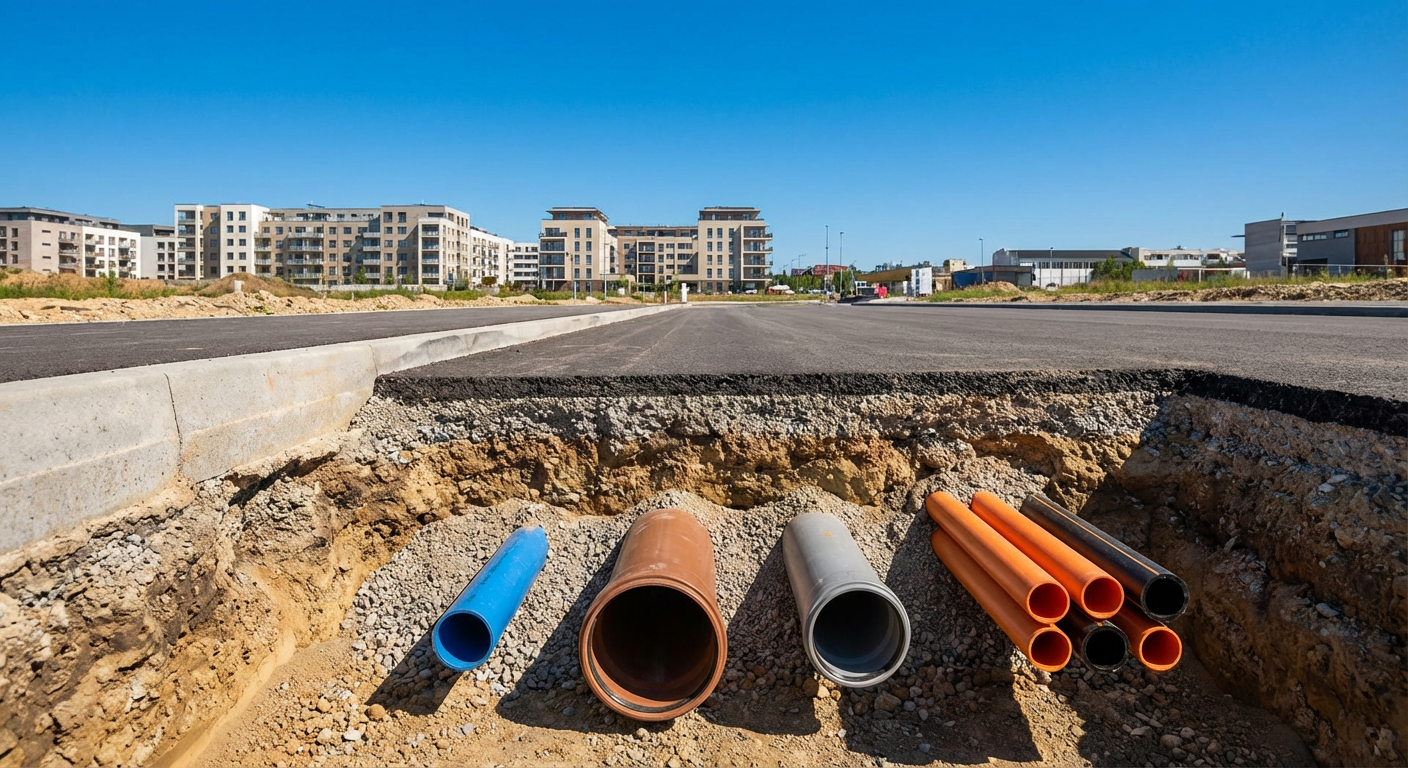
The most dangerous misconception among bare land condominium boards in Alberta is that municipal authorities maintain all underground utilities. In reality, many bare land developments include privately-owned water distribution systems, sanitary sewer collection systems, and storm drainage infrastructure that the municipality will never touch.
Consider a typical scenario in a bare land development near St. Albert: A 12-unit community built in 2005 features private roads and underground utilities connecting to the municipal system at the development's entrance. The developer installed these systems to city standards, but ownership transferred to the condominium corporation upon registration. Twenty years later, the PVC sewer lines begin to fail, requiring complete replacement at a cost exceeding $300,000.
Without an accurate Alberta Reserve Fund Study that identified this liability years in advance, the corporation faces two choices: drain the reserve fund (leaving nothing for road repairs) or impose a massive special assessment that could range from $25,000 per unit. In communities with lower property values, such assessments can exceed 25% of the unit's market value, creating severe financial hardship and potentially forcing sales.
The Professional Engineer Advantage
Assessing underground infrastructure requires specialized expertise that goes far beyond visual inspection. A qualified Professional Engineer (P.Eng.) with engineering experience brings critical capabilities to bare land reserve fund studies:
- Accurate condition assessment - Understanding deterioration patterns in buried pipes, identifying risk factors like soil conditions and installation methods, and predicting failure timelines
- Replacement cost estimation - Accounting for excavation costs, traffic management, restoration of road surfaces, and regulatory compliance in Alberta
- Alternative analysis - Evaluating options like trenchless pipe rehabilitation, phased replacement strategies, or system upgrades that improve long-term performance
- Regulatory knowledge - Ensuring planned work complies with Alberta Environment and Parks requirements, municipal bylaws, and safety codes
When you Request a quote for a reserve fund study in Alberta, verify that the provider employs or partners with Professional Engineers experienced in civil infrastructure. The cost difference between a basic study and one conducted with proper engineering expertise is minimal compared to the financial risk of underestimating infrastructure needs.
Roadway Depreciation and Lifecycle Planning
Private roadways represent another significant but often underestimated liability in bare land developments across Alberta. While visible and seemingly straightforward, proper roadway lifecycle planning requires understanding multiple factors:
- Climate impacts in Alberta - Freeze-thaw cycles, snow removal operations, and ice control chemical applications all accelerate pavement deterioration in our climate. A roadway in Medicine Hat may last 25 years, while one in Edmonton exposed to heavier snow clearing might require replacement in 18 years.
- Traffic patterns and loading - Roads serving only residential traffic experience different wear patterns than those accommodating regular delivery trucks, service vehicles, or RV storage traffic. Your reserve fund study must account for actual usage patterns in your specific community.
- Maintenance history - Proper crack sealing, seal coating, and pothole repair can extend roadway life by 5-10 years. Conversely, deferred maintenance accelerates deterioration and increases eventual replacement costs. An experienced reserve fund study provider in Alberta will review maintenance records and incorporate their findings into lifecycle projections.
- Overlay versus reconstruction - Not every failing roadway requires complete reconstruction. In many cases, asphalt overlay—essentially paving over the existing surface—can restore serviceability at 40-60% of reconstruction costs. However, this option depends on the condition of the base structure, requiring proper engineering assessment.
For bare land corporations in the Edmonton area, our Reserve Fund Study in Edmonton service includes detailed assessment of roadway conditions and replacement planning. Similar specialized services are available through our Reserve Fund Study in Calgary and Reserve Fund Study in Red Deer offerings.
Managed Bare Land: The Hybrid Trap That Catches Boards Off Guard
Understanding Managed Bare Land Provisions
Some bare land condominium developments in Alberta include provisions in their bylaws or condominium plan that give the corporation responsibility for maintaining certain building components. These "managed bare land" arrangements create a hybrid ownership structure that significantly increases reserve fund obligations.
Common managed components include:
- Roofing systems - The corporation maintains and replaces all unit roofs on a scheduled basis
- Exterior siding and cladding - Painting, repair, or replacement of exterior finishes falls to the corporation
- Windows and doors - Sometimes limited to front-facing elements visible from streets
- HVAC equipment - In developments with centralized systems or where the corporation maintains individual unit furnaces
- Garages or carports - Structures attached to units but defined as common property
These provisions often emerge during the development phase as selling features. Developers market the community as "worry-free" with the corporation handling major building maintenance. However, once the corporation takes control, board members sometimes discover these obligations without understanding their financial implications.
The Bylaw Review Imperative
A critical early step in preparing any Alberta Reserve Fund Study for a bare land development involves thorough review of the condominium plan, bylaws, and any amendments. This review must identify:
- Defined common property - What the corporation legally owns and maintains
- Maintenance obligations - What the corporation must maintain even if not technically owned
- Owner responsibilities - What remains the individual unit owner's obligation
- Opt-in or opt-out provisions - Whether owners can elect in or out of corporate maintenance programs
Without this detailed legal review, reserve fund studies can miss millions of dollars in future liabilities. Consider a 40-unit managed bare land development near Airdrie where the corporation maintains all roofs. With metal roofing systems costing $15,000-20,000 per unit to replace and a 30-year lifecycle, the corporation faces a $600,000-800,000 liability that many boards overlook until the study is conducted.
Professional reserve fund study providers in Alberta should never rely on verbal explanations from board members about corporate responsibilities. Document review must be exhaustive, and any ambiguities should be clarified with legal counsel before finalizing the study.
Impact on Reserve Fund Contributions
Managed bare land provisions dramatically affect the financial planning component of reserve fund studies. A bare land corporation with only infrastructure responsibilities might maintain a reserve fund of $50,000-150,000 for a small development. Add roofing and siding responsibilities, and that figure could jump to $500,000 or more.
The funding implications flow through to monthly contributions. Unit owners in managed bare land developments often pay condominium fees comparable to attached townhouse complexes, typically $200-400 per month rather than the $50-150 monthly fees common in unmanaged bare land settings.
This reality creates challenges when boards consider transitioning from managed to unmanaged status (or vice versa). Such changes require bylaw amendments, owner approval, and complete revision of the reserve fund study. Boards contemplating these changes should Get a Reserve Fund Study quote to understand the financial implications before proceeding with owner votes.
Special Assessment Risk in Small Bare Land Corporations

The Mathematics of Shared Burden
Small bare land condominium corporations face disproportionate financial vulnerability compared to larger communities. The mathematics are straightforward but consequential: fewer unit owners means each bears a larger share of infrastructure costs.
Consider two scenarios in Alberta bare land developments:
- Scenario A: 50-unit development in Sherwood Park - Private roadway replacement cost: $400,000
- Cost per unit: $8,000
- Monthly contribution over 20 years (at 2% interest): approximately $35/month per unit
- Scenario B: 10-unit development in Leduc - Private roadway replacement cost: $150,000 (less total infrastructure but higher per-unit cost due to engineering and mobilization minimums)
- Cost per unit: $15,000
- Monthly contribution over 20 years (at 2% interest): approximately $62/month per unit
The 10-unit corporation pays nearly double per unit despite having less total infrastructure. When unexpected repairs arise—a collapsed sewer line, retaining wall failure, or premature roadway deterioration—small corporations have little financial cushion.
The Special Assessment Spiral
When bare land corporations in Alberta lack adequate reserve funds, special assessments become inevitable. These one-time charges to unit owners can range from a few thousand dollars to tens of thousands per unit, depending on the scope of work required.
Special assessments create several negative consequences:
- Property value impact - Real estate listings must disclose recent or upcoming special assessments, deterring buyers and reducing sale prices
- Owner financial hardship - Many owners, particularly retirees or first-time home buyers, cannot absorb large unexpected costs without borrowing
- Deferred maintenance pressure - Boards may delay necessary work to avoid imposing assessments, leading to more expensive emergency repairs later
- Community conflict - Special assessments often generate owner disputes, board member resignations, and contentious annual meetings
The solution lies in proactive planning through regular reserve fund studies that accurately project needs and maintain adequate funding levels. While higher monthly contributions feel burdensome, they're far preferable to the alternatives that underfunded corporations face.
The Role of Contingency Planning
Alberta reserve fund studies should include contingency provisions that account for unexpected conditions or cost escalations. This is particularly important in bare land developments where buried infrastructure can reveal hidden problems during excavation.
Best practices include:
- 15-20% contingency on infrastructure projects - Underground work frequently encounters unexpected conditions like contaminated soil, conflicting utilities, or rock excavation
- Annual inflation adjustments - Construction cost inflation in Alberta has exceeded general inflation rates in many recent years
- Condition assessment intervals - Regular professional inspections of critical infrastructure between full study updates
- Emergency reserve provisions - Maintaining a portion of the reserve fund accessible for unexpected failures
Boards seeking guidance on appropriate contingency planning should consult with experienced reserve fund study providers who understand Alberta market conditions and regulatory requirements.
Alberta-Specific Regulatory Considerations for Bare Land Condos
Five-Year Update Requirements
The Condominium Property Regulation in Alberta mandates reserve fund study updates at least once every five years. This requirement applies universally to bare land developments regardless of size or asset value.
Many boards question whether annual or biennial updates might serve them better, particularly in developments with aging infrastructure or rapid deterioration conditions. While not required, more frequent updates offer several advantages:
- Earlier identification of accelerated deterioration - Infrastructure doesn't always fail on predictable schedules
- More accurate cost estimation - Construction costs fluctuate significantly over multi-year periods
- Improved financial planning - Boards can adjust contribution levels gradually rather than implementing sudden increases
- Reduced special assessment risk - More frequent updates prevent surprises from conditions that develop between studies
The cost of interim updates is typically 50-70% of a full study since the provider can reference previous work and focus on changed conditions or updated cost data. This represents a modest investment compared to the financial protection provided.
Compliance with Professional Practice Standards
Professional Engineers conducting reserve fund studies in Alberta must adhere to practice standards established by the Association of Professional Engineers and Geoscientists of Alberta (APEGA). These standards ensure:
- Competent practice - Engineers must work within their areas of competence and expertise
- Professional judgment - Assessments must be based on sound engineering principles and professional judgment, not simply historical averages or rule-of-thumb estimates
- Appropriate methodology - Site visits, condition assessments, and analysis methods must be suitable for the specific development and its components
- Proper documentation - Studies must be clearly documented with assumptions, methodologies, and limitations explicitly stated
When evaluating reserve fund study providers for your bare land condominium in Alberta, verify that Professional Engineers with relevant civil engineering experience will conduct or review the infrastructure assessments. This isn't merely a preference—it's essential for receiving a study that meets professional standards and actually protects your corporation.
Municipal Coordination and Utility Ownership
Bare land condominium boards in Alberta often struggle to determine exactly where municipal responsibility ends and corporate responsibility begins. This boundary varies by municipality and can even vary within a single city depending on when the development was approved and built.
Critical questions to resolve include:
- Water main responsibility - Does the municipality maintain distribution lines within the development or only to a connection point?
- Sewer system ownership - Who owns collection systems, manholes, and lift stations within the development?
- Storm drainage - Does the city maintain storm sewers, catch basins, and retention ponds?
- Road maintenance - Are private roads maintained by the city under contract, or does the corporation bear full responsibility?
- Snow removal - Do municipal services extend to private roads in the development?
Most Alberta municipalities maintain detailed records of infrastructure ownership and responsibility. Board members should request written clarification from the municipal engineering department, ideally obtaining maps showing exactly where public and private systems interconnect. This documentation should be provided to your reserve fund study provider to ensure accurate asset identification.
Financial Planning Strategies for Bare Land Reserve Funds
Funding Models: Threshold vs. Baseline
Reserve fund studies in Alberta typically present funding recommendations using one of two approaches:
Threshold funding aims to maintain the reserve fund balance above a minimum level (often defined as a percentage of total replacement value) while allowing the balance to fluctuate over time. This approach results in variable contribution requirements, with increases needed before major expenditures and potential decreases afterward. Baseline funding seeks to maintain relatively stable reserve fund contributions over time, with the balance growing steadily to accommodate future needs. This approach appeals to bare land corporations because it provides predictability in condominium fees and avoids sudden increases that can shock unit owners.Most bare land developments in Alberta benefit from baseline funding approaches. The predictability helps with owner budgeting and property marketability. However, very small corporations or those with severely underfunded reserves may need to implement threshold funding initially to build reserves more aggressively.
Interest Rate Assumptions and Investment Strategy
Alberta reserve fund studies must assume an interest rate for reserve fund investments. This rate significantly affects long-term funding projections—higher assumed rates reduce required contributions, while conservative rates increase them.
Best practices in Alberta currently suggest:
- 1.5-2.5% interest assumptions - Reflecting realistic returns on low-risk investments appropriate for reserve funds
- Conservative bias - It's better to accumulate excess reserves than to fall short due to optimistic return assumptions
- Periodic review - Investment return assumptions should be reviewed during each study update to reflect current market conditions
Bare land corporations should work with their financial institutions to develop investment strategies that balance safety, liquidity, and returns. Reserve funds must remain available for planned expenditures, so long-term locked investments are generally inappropriate regardless of their higher potential returns.
Addressing Chronic Underfunding
Many bare land condominium corporations in Alberta discover during their first professional reserve fund study that they're significantly underfunded—sometimes by hundreds of thousands of dollars. This typically results from:
- Inadequate initial funding - Developers often set initial contribution levels too low to make units marketable
- Deferred study updates - Corporations that exceed the five-year update requirement fall behind in planning
- Unexpected deterioration - Infrastructure that fails prematurely creates unanticipated funding gaps
- Special assessment diversions - Boards that levy special assessments instead of increasing regular contributions
Addressing chronic underfunding requires difficult decisions. Options include:
- Gradual contribution increases - Implementing 10-15% annual contribution increases over several years to build reserves without overwhelming owners
- Combined approach - Using a one-time special assessment to address immediate underfunding while increasing regular contributions to maintain adequate future funding
- Expenditure deferral - Carefully deferring non-critical work (never safety-related items) to allow reserves to build, then addressing deferred items systematically
- Long-term planning acceptance - Acknowledging that it may take 10-15 years to reach fully funded status and communicating this timeline transparently to owners
The worst approach is ignoring the problem. Underfunded bare land corporations eventually face crises—major component failures with insufficient funds to address them —creating emergency conditions and forcing expensive reactive repairs.
Reserve Fund Studies Across Alberta
We provide Reserve Fund Studies for condominium corporations across Alberta, including Edmonton, Calgary, and Red Deer.
Ready to get started? Get a Quote →