An underfunded condo reserve fund means the current balance, plus the contributions the corporation plans to make, will not cover the repairs and replacements the building is expected to need over the study period. Many boards only find out when a major component fails and a special assessment is on the table.
This guide shows how to check where your corporation stands: the financial, physical and governance warning signs, what usually causes underfunding, and the options a board has to correct it. The reserve fund study is what gives a firm answer, and in Alberta the Condominium Property Regulation requires a new one on or before 5 years from the day the most recent reserve fund plan was approved (s.30).
Need a Reserve Fund Study in Edmonton?
Brookstone Engineering is a reserve fund study provider with in-house APEGA-licensed Professional Engineers (P.Eng.). Request a Reserve Fund Study Quote (Edmonton)
What Does "Underfunded" Really Mean for Your Reserve Fund?
Understanding reserve fund underfunding requires looking beyond simple account balances. A reserve fund is underfunded when the current balance and planned future contributions are insufficient to cover the projected costs of major repairs and component replacements over the fund's planning period.
Four Levels of Reserve Fund Health
Reserve fund health exists on a spectrum, and understanding where your building falls can help you take appropriate action. Alberta condos typically fall into these percent-funded ranges, the same bands used in our peer benchmarking guide:
- Excellent (85-100%): Strong financial position with minimal special assessment risk. A fund at 100% holds the full fully funded balance, which reflects the current accumulated depreciation of all major building components.
- Good (70-84%): Adequate funding with manageable future requirements.
- Fair (50-69%): Below optimal levels; contribution increases likely needed.
- Poor (Below 50%): Significant underfunding requiring immediate attention. At the low end of this range, necessary repairs may already be overdue or coming due soon.
How Reserve Fund Studies Calculate Funding Status
When a qualified engineer conducts a Reserve Fund Study in Edmonton or elsewhere in Alberta, they calculate your percent funded by comparing your current reserve fund balance to the fully funded balance—the amount you would need if all components were replaced today based on their age and condition.
The formula is straightforward: (Current Reserve Balance ÷ Fully Funded Balance) × 100 = Percent Funded
A building with $500,000 in reserves but a fully funded balance of $800,000 would be 62.5% funded—in the Fair range, where contribution increases are likely needed. However, the trend matters as much as the snapshot. A building declining from 80% to 62% over three years signals a worsening problem that demands intervention.
What Are the Warning Signs Your Reserve Fund Is Underfunded?
Identifying underfunding early allows boards to implement gradual solutions rather than emergency measures. Watch for these red flags that indicate your Alberta condominium may be heading toward—or already experiencing—reserve fund underfunding.
Financial Red Flags
Your financial statements and budget documents often reveal underfunding before physical problems become apparent:
- Declining Reserve Fund Balances: If your year-end reserve balance has decreased for two or more consecutive years despite regular contributions, you're spending reserves faster than you're replenishing them.
- Low Percent Funded: A balance that sits well below the fully funded balance in your latest reserve fund study (see the levels above) suggests underfunding, particularly in older buildings.
- Increasing Frequency of Special Assessments: If your board has issued special assessments for routine capital projects (not emergencies) more than once in five years, it indicates chronic underfunding.
- Deferred Projects on Your Reserve Fund Study: When your most recent study shows projects being pushed further into the future compared to the previous study, you're deferring maintenance due to insufficient funds.
- Reserve Contributions Below Study Recommendations: If your board has not implemented the contribution increases recommended in your last Reserve Fund Study services in Alberta, you're falling further behind the funding schedule.
Physical Warning Signs
The condition of your building itself provides crucial clues about reserve fund health:
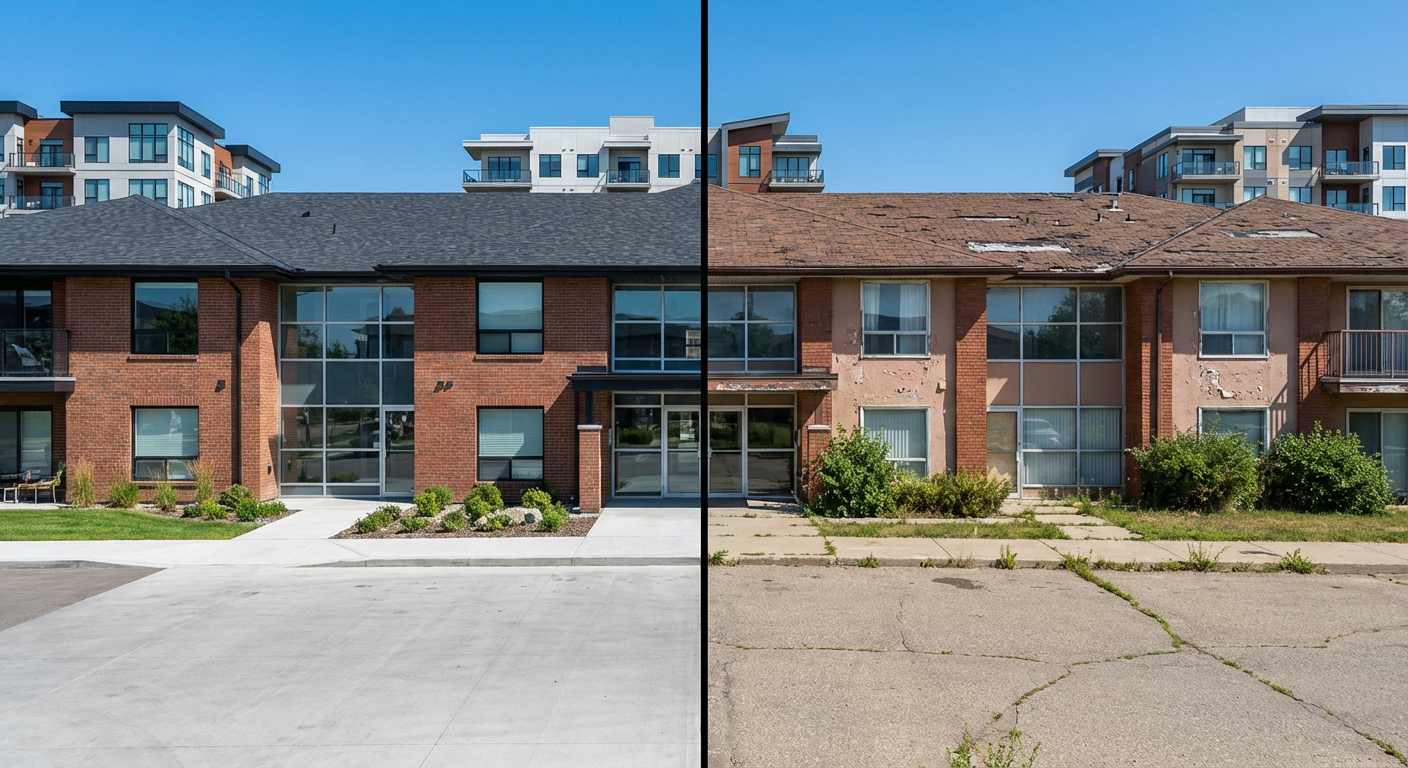
- Visible Deferred Maintenance: Peeling paint, cracked parking lots, aging roofs beyond their expected lifespan, or outdated building systems indicate postponed projects due to funding constraints.
- Emergency Repairs Instead of Planned Replacements: If you're patching and emergency-repairing components that should have been replaced on schedule, you're experiencing the consequences of underfunding.
- Multiple Systems Reaching End of Life Simultaneously: Buildings with several major components (roof, boiler, parkade membrane) all overdue for replacement face a funding crisis if reserves can't cover multiple simultaneous projects.
Governance and Planning Red Flags
How your board manages planning and decision-making can indicate underlying funding problems:
- No New Reserve Fund Study Within 5 Years of Plan Approval: Under the Condominium Property Regulation (s.30), a new study is required on or before 5 years from the day the most recent reserve fund plan was approved. Boards that delay studies often do so because they're avoiding bad news about funding status.
- Board Reluctance to Increase Reserve Contributions: When board members consistently vote against recommended contribution increases to avoid owner complaints, they're compounding underfunding problems.
- Lack of Long-Term Planning: Boards operating year-to-year without reference to their reserve fund study or capital plan are flying blind regarding funding adequacy.
How Did Your Reserve Fund Become Underfunded?
Understanding the root causes of underfunding helps prevent future recurrence and builds owner support for corrective measures. Reserve fund underfunding rarely results from a single decision—it typically develops over years through a combination of factors.
Inadequate Initial Funding and Low Historical Contributions
Many Alberta condominium corporations, particularly those established before modern reserve fund requirements, started with minimal reserve contributions. Developers often set initial contribution levels artificially low to make units more marketable, leaving new boards with chronically underfunded reserves.
Buildings constructed in the 1970s, 1980s, and even early 1990s frequently established reserve contributions at low levels relative to their operating budgets—levels that proved inadequate for long-term capital needs. Even when boards commissioned a Reserve Fund Study in Calgary that recommended higher contributions, they often implemented only partial increases to minimize owner resistance.
Inaccurate or Outdated Reserve Fund Studies
A reserve fund study is only as good as its data and assumptions. Studies that underestimate replacement costs, overestimate component lifespans, or fail to identify deteriorating conditions create a false sense of security. Boards relying on outdated studies are making decisions based on obsolete information that doesn't reflect current costs or conditions.
Some earlier studies were also prepared by unqualified practitioners without engineering expertise, leading to significant errors in component assessment and cost projection. Alberta's requirement that reserve fund studies be conducted by qualified professionals addresses this issue, but buildings still operating under old, inadequate studies remain at risk.
Unexpected Major Repairs and Emergencies
Even well-funded reserves can be depleted by unforeseen events. Major weather damage, premature component failure, discovery of latent defects, or emergency safety repairs can consume years of accumulated reserves in a single project.
While a healthy reserve fund includes contingency allowances for unexpected costs, multiple emergencies or a single catastrophic event can overwhelm even prudent planning. The 2020 Calgary hailstorm, for example, forced many condominium corporations to undertake extensive roof and siding repairs not anticipated in their reserve fund studies.
Board Decisions to Defer Contributions or Maintenance
Well-intentioned boards sometimes make short-term decisions that create long-term funding problems. Common scenarios include:
- Freezing or reducing reserve contributions during economic downturns to ease owner financial burden
- Diverting reserve funds to operating budget shortfalls (where legally permitted)
- Voting to delay recommended projects to avoid special assessments or contribution increases
- Choosing the cheapest repair options that require more frequent replacement rather than investing in quality
Each decision seems reasonable in isolation, but collectively they create a pattern of chronic underfunding that becomes increasingly difficult to reverse.
Inflation and Construction Cost Escalation
Even with disciplined contributions matching reserve fund study recommendations, unexpected inflation can erode purchasing power. Construction costs can rise faster than general inflation, as supply chain disruptions, labour shortages and material cost pressures have shown in recent years.
As a hypothetical example, a reserve fund study prepared in 2019 projecting $150,000 for a roof replacement in 2024 may find actual costs approaching $200,000 or more—a 33% shortfall through no fault of the board or engineer who prepared the study. This inflation risk highlights why Alberta condominium corporations need regular reserve fund study updates that adjust cost projections to current market realities. For a current reference point, Statistics Canada's Building construction price indexes, second quarter 2026 put Edmonton non-residential construction prices up 4.0% year over year, although the index tracks new construction rather than condo repair work, so treat it as a general signal and not a line-item adjustment.
What Are Your Options for Correcting Reserve Fund Underfunding?
Discovering that your reserve fund is underfunded isn't the end of the world—it's the beginning of solution implementation. Alberta condominium boards have several strategies available to correct underfunding, each with distinct advantages and challenges.
Gradual Contribution Increases
The most sustainable and owner-friendly approach involves phased reserve contribution increases over several years. Instead of shocking owners with a single dramatic increase, boards implement annual incremental increases until the fund reaches adequate levels.
- Advantages: Spreads financial impact over time, allows owners to budget and plan, maintains board-owner relationships, and demonstrates responsible governance.
- Challenges: Requires years to fully correct underfunding, may not work for critically underfunded buildings with imminent major projects, and requires board continuity and discipline to sustain the plan.
A qualified P.Eng. conducting your Reserve Fund Study in Red Deer or anywhere in Alberta can model different contribution increase scenarios, showing the funding trajectory under various approaches. This data helps boards select a contribution schedule that balances financial responsibility with owner affordability.
Special Assessments for Specific Projects
When underfunding is moderate and specific projects require immediate funding, special assessments targeted to those projects provide a direct solution. This approach preserves existing reserve funds for other planned projects while raising capital for urgent needs.
- Advantages: Directly funds specific projects without long-term commitment, easier to justify to owners when tied to visible needs, and can address critical underfunding for individual components.
- Challenges: Creates financial hardship for some owners, may reduce property marketability during assessment period, requires owner approval in many cases, and doesn't address systemic underfunding.
Boards pursuing special assessments should clearly communicate the project necessity, cost justification, and how the assessment addresses specific underfunding without solving broader reserve fund inadequacy.
Reserve Fund Loans
Corporations may be able to borrow, subject to their bylaws and owner approval requirements; confirm with your lawyer. Some Alberta condominium corporations explore borrowing to fund major projects while implementing contribution increases to repay the loan. This approach can be a useful bridge when emergency repairs can't wait for reserves to accumulate but special assessments would create owner hardship.
- Advantages: Provides immediate capital for critical projects, spreads repayment over multiple years similar to contribution increases, and may offer better terms than special assessment payment plans.
- Challenges: Adds debt service to operating costs, may require owner approval, limits future borrowing capacity, and can be difficult to obtain for buildings with poor financial health.
Reserve fund loans work best as bridges, not long-term solutions. Boards should ensure their contribution increase plan will both repay the loan and adequately fund ongoing reserve needs.
Combination Approaches
Most successfully remediated underfunding situations employ multiple strategies simultaneously. A typical approach might include:
- Moderate special assessment for the most urgent current project
- Reserve fund loan for the second priority project requiring immediate attention
- Phased contribution increases over several years to restore adequate ongoing funding
- Project prioritization to defer less critical work until funding improves
This balanced approach addresses immediate needs while building long-term sustainability. A professional conducting your reserve fund study can help model combination scenarios to find the optimal balance for your specific situation.
When to Consider Professional Reserve Fund Management
Severely underfunded buildings benefit from professional reserve fund management beyond the standard engineering study. Some firms offer ongoing advisory services that include:
- Annual interim reserve fund updates between full studies
- Project prioritization assistance and contractor bid evaluation
- Owner communication support and funding plan presentations
- Progress monitoring and adjustment recommendations
This ongoing support helps boards stay on track with remediation plans and make course corrections as circumstances change.
How Do You Conduct a Reserve Fund Health Check?
Between formal reserve fund studies, Alberta condominium boards should conduct regular informal health checks to monitor funding adequacy and identify emerging issues before they become critical.
DIY Reserve Fund Assessment Steps
Board members can perform a basic reserve fund health assessment using your most recent reserve fund study and current financial statements:
- Step 1: Calculate Your Current Percent Funded - Locate your current reserve fund balance from the latest financial statement
- Find the "fully funded balance" from your most recent reserve fund study (may require adjusting for inflation if the study is several years old)
- Divide current balance by fully funded balance and multiply by 100
- Step 2: Compare Actual vs. Recommended Contributions - Review your reserve fund study's recommended annual contributions
- Compare these to your actual budgeted and collected contributions since the study
- Calculate the cumulative shortfall if you've been contributing below recommendations
- Step 3: Review Project Timing and Status - List all projects your reserve fund study scheduled for completion by now
- Identify which have been completed, deferred, or remain pending
- Calculate the total cost of deferred projects
- Step 4: Assess Upcoming Project Readiness - Identify projects scheduled in the next 2-3 years
- Confirm your current balance plus expected contributions will cover these costs
- Flag any shortfalls requiring special attention
- Step 5: Monitor Financial Ratios - Calculate your percent funded (current reserve balance ÷ fully funded balance) and compare it with the levels above
- Track year-over-year reserve balance changes (should be increasing annually)
- Review special assessment frequency over the past 5-10 years
When to Commission a Professional Assessment
DIY health checks provide valuable insights, but certain situations require professional evaluation by a qualified P.Eng.:
- Your reserve fund study is more than 3 years old: Cost inflation and condition changes may have significantly altered funding requirements
- Major unexpected repairs have depleted reserves: Professional assessment helps determine whether your funding plan remains viable
- Persistent deferred maintenance is accumulating: Engineering expertise can evaluate whether deferral is creating compounding problems
- Board members disagree about funding adequacy: An independent professional assessment provides objective data
- You're approaching major expenditures: Updated projections ensure adequate funding before committing to large projects
Many Alberta condominium corporations schedule interim engineering assessments at the 2-3 year mark between full reserve fund studies. These focused evaluations update critical cost projections and funding calculations without the full scope of a comprehensive study.
Leveraging Your Reserve Fund Study Data
If your existing reserve fund study is relatively recent (within 2-3 years), you can extend its usefulness by making simple adjustments:
- Inflation Adjustments: Apply current construction cost inflation to projected costs, using a recognized cost index such as the Statistics Canada indexes noted above
- Interest Rate Updates: Adjust expected reserve fund investment returns to reflect current rates
- Component Condition Updates: Note any accelerated deterioration or extended component life since the study
- Completed Project Accounting: Update the study spreadsheet to reflect projects completed since publication
While these adjustments don't replace a professional update, they provide more accurate funding pictures than working with unmodified historical data. When you're ready for a comprehensive update, Request a quote from qualified reserve fund study providers serving your Alberta community.

How Can You Communicate Underfunding to Owners?
Once your board identifies reserve fund underfunding, effective owner communication becomes critical to building support for corrective measures. How you present the information can determine whether owners support necessary actions or resist them.
Framing the Issue Properly
Avoid presenting underfunding as a failure or crisis. Instead, frame it as a discovered opportunity to improve the building's financial health before problems escalate. Use language that emphasizes:
- Proactive management: "We identified this issue through diligent review, giving us time to address it gradually."
- Fiduciary responsibility: "As your board, we're committed to maintaining property values and avoiding emergency assessments."
- Common challenge: "Many Alberta condominium corporations face similar situations as buildings age and costs increase."
- Concrete solutions: "We've developed a specific plan to restore adequate funding over [timeframe]."
Using Data Effectively
Numbers speak louder than opinions when explaining underfunding. Present clear, visual data that helps owners understand the situation:
- Percent funded comparisons: Show where you are versus where you should be, with benchmarks for reference
- Project timeline charts: Illustrate upcoming projects and how current funding would (or wouldn't) cover them
- Cost projection graphs: Demonstrate inflation's impact on future project costs
- Scenario comparisons: Present side-by-side comparisons of different funding approaches and their long-term outcomes
Many reserve fund study providers, including those offering reserve fund studies in Edmonton, can prepare owner-friendly presentation materials that translate technical study findings into accessible graphics and summaries.
Addressing Common Owner Concerns
Anticipate and directly address the questions and objections owners are likely to raise:
"Why didn't previous boards address this?"Explain contributing factors without blaming predecessors. Many boards made decisions appropriate to their circumstances that created cumulative effects. Focus on moving forward rather than assigning fault.
"Can't we just do cheaper repairs?"Clarify that quality replacements are more cost-effective long-term than repeated cheap fixes. Show cost comparisons demonstrating this principle.
"Why should I pay more—I'm selling soon?"Emphasize that underfunded buildings sell for less. Addressing underfunding protects everyone's property values, including those planning to sell. Well-funded reserves are selling features.
"What if I can't afford increased contributions?"Acknowledge financial challenges while explaining that gradual increases are less burdensome than special assessments. Discuss any payment plan options available.
Building Owner Support Through Transparency
Regular, consistent communication builds trust and support for difficult decisions:
- Annual reserve fund reports: Provide clear updates on funding status, completed projects, and upcoming work
- Educational sessions: Host informal presentations explaining reserve funds, the reserve fund study process, and funding principles
- Project updates: Share progress reports on major projects, including how they're tracking against budget
- Accessible board members: Encourage owners to ask questions and provide feedback on reserve fund planning
Boards that communicate openly about reserve fund matters—both good news and challenges—find greater owner support when addressing underfunding issues.
Reserve Fund Studies Across Alberta
We provide Reserve Fund Studies for condominium corporations across Alberta, including Edmonton, Calgary, and Red Deer.
Ready to get started? Get a Quote →